A new controversy has emerged within sections of the Ahom community, with some individuals promoting the idea of a distinct Tai ethnicity called Tai Mo. According to this interpretation, certain surnames associated with the traditional Ahom priesthood represent the original Tai population, supposedly distinct from the wider Ahom community.
Recently, discussions on social media have suggested that Mohong, Moplong, Moseng, Mosai and Changbun (among others) should be identified as Tai Mo rather than Tai Ahom. The underlying argument appears to be that these groups possess a distinct ancestral identity, supposedly traceable to the Tai migrants who accompanied Tsaolung Serkapha to Assam.
However, such claims deserve closer examination. Are these names really evidence of a separate ethnic identity, or are we looking at occupational and functional designations that have gradually become associated with particular families? More importantly, was Ahom priesthood actually hereditary, or was it fundamentally based on occupation and specialized knowledge?
In this article, we will examine the linguistic and historical arguments surrounding the Tai Mo controversy and question the assumption that traditional Ahom priestly designations necessarily represent hereditary clans or separate ethnic groups.
The Origin of the Tai Mo Controversy
As the Census exercise approaches, there has been increasing discussion within sections of the Ahom community about how language, religion and ethnic identity should be recorded. Some individuals have encouraged Ahoms to identify their language as Tai Assamese and their religion as Ahom Hindu. We have discussed some of these suggestions previously.
Against this background, the promotion of another identity, namely Tai Mao or Tai Mo, should not come as an entirely unexpected development.
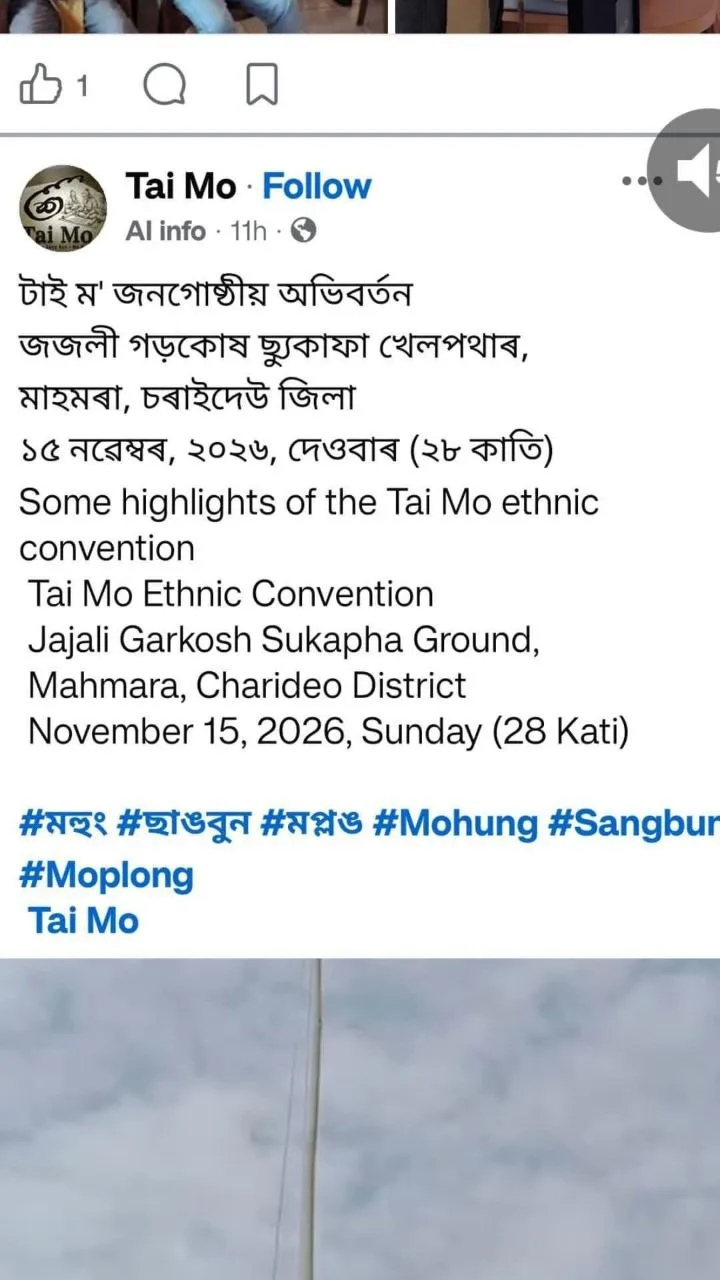
A Facebook page associated with the Tai Mo identity movement.
The central proposition behind this identity appears to be that Mohong, Moplong, Moseng and certain other priestly or traditional surnames represent the original Tai population, whereas the wider Ahom population consists largely of local communities who were subsequently incorporated into Ahom society.
In other words, people bearing these particular surnames are being presented as descendants of the original Tai migrants from Yunnan, while other Ahoms are implicitly assigned a different ancestral status.
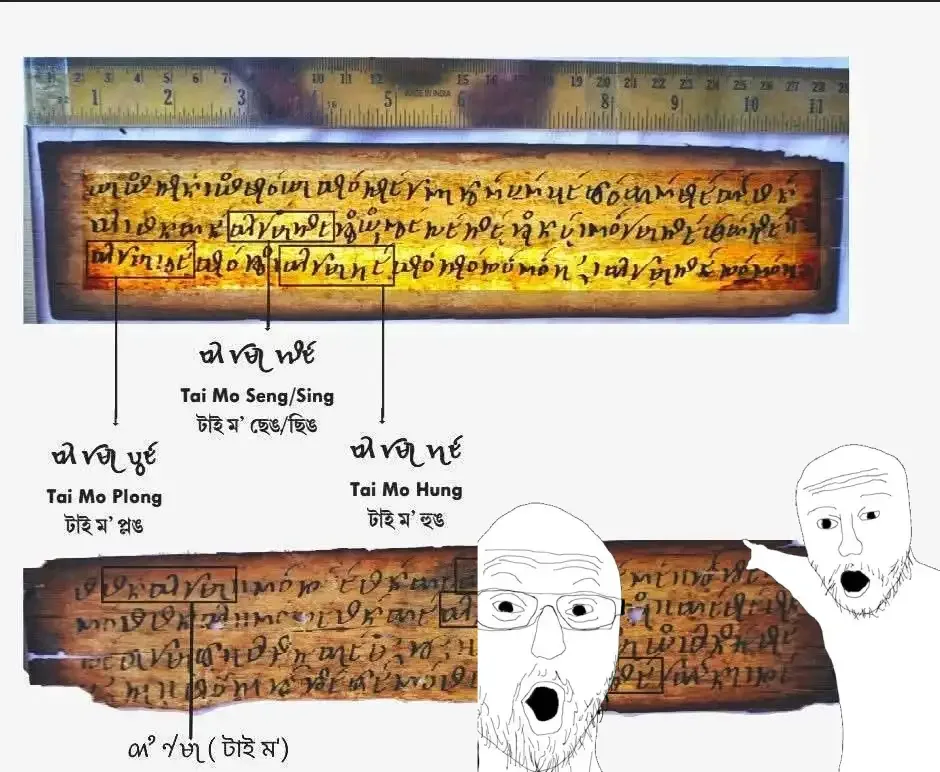
To support this interpretation, some proponents have also circulated manuscript material containing the expression Tai Mo, presenting it as evidence of a distinct ethnic category.
Manuscript material circulated as evidence for the proposed Tai Mo identity.
But the appearance of two words together in a manuscript does not automatically establish the existence of a separate ethnic group. To understand the expression properly, we must first examine how the word Tai is used in Ahom manuscripts and how its meaning changes according to context.
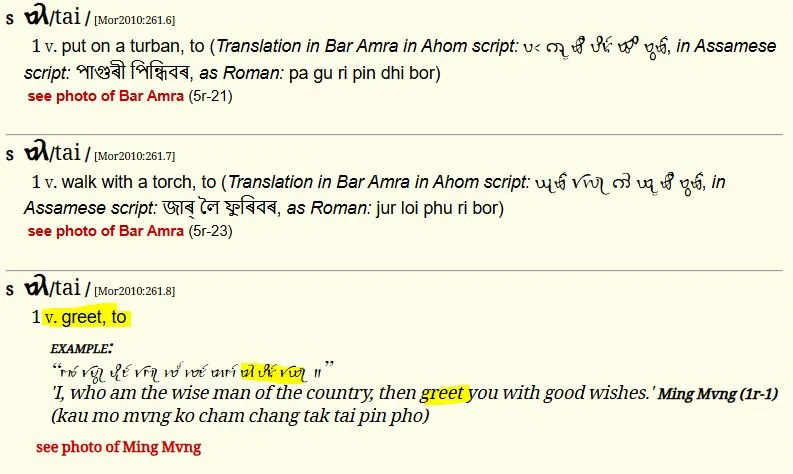
An example illustrating the importance of understanding the word Tai in its manuscript context.
One of the meanings attributed to the word Tai in the manuscript material discussed here is associated with greeting or addressing someone. Consequently, expressions such as Tai Mohong, Tai Mopong and Tai Moseng should be understood as greeting the priests, shamans, philosophers, and folk artists and not as the names of separate ethnic groups without even examining their grammatical construction and context.
This is a classic case of cherry-picking where someone just picks two three words out of an entire paragraph to prove his point. The idea of translating the manuscript didn't even occur to our esteemed scholar who made this feature graphic.
Tai Mao: An Ethnic Designation or a Misunderstood Expression?
A significant part of this discussion revolves around the distinction between Mao and Mo, two expressions that should not be treated as interchangeable merely because their Romanised spellings appear similar.
In the expression Tai Mao, máao is understood as referring to a Tai people, tribe or ethnic grouping. The Ahoms themselves belong to the wider historical Tai population.
However, Mo (maw) has a different range of meanings. Depending on its grammatical usage and context, it can be associated with a master, specialist or shaman in its nominal sense, and with knowing or possessing knowledge in its verbal sense.
This distinction becomes particularly relevant when examining traditional Ahom occupational and specialist designations.
For instance, the elements hung and hong should not be confused. The former is associated with cooking or boiling, while the latter is associated with fame or renown. Their distinction is important when interpreting names such as Mohung and Mohong.
Accordingly, the following interpretations have been proposed:
Mohung (maw hung): Associated with knowing how to cook or prepare food; in an occupational context, this can be understood as a cook or chef.
Mohong (maw hong): Associated with a renowned master or specialist, and interpreted in certain contexts as a shaman or religious specialist.
These interpretations illustrate why the names should be examined through their linguistic components rather than automatically classified as hereditary ethnic or clan names.
The same approach has been suggested for other designations, including Mopong (philosopher), Moseng (courtesan), Mosai (spiritualist) and Changwon (thinker). Their precise historical meanings and usage, however, should be established through manuscript evidence rather than assumed from modern surname forms.
There is another important distinction worth considering. The word tsāang is associated with skill, while wôn is associated with thinking or intellectual activity. A designation formed from these elements may therefore describe a particular ability or specialisation rather than an inherited identity.
The same principle can be observed in the word Changmai (ช่างไม้), which literally means carpenter in Thai. The expression refers to a person skilled in woodworking. It is an occupational designation, not necessarily the name of a distinct ethnic group or hereditary community.
Therefore, the assumption that every traditional designation must represent a distinct clan requires considerably more evidence. A linguistic expression describing an occupation or specialisation cannot, by itself, establish the ancestry of everyone who subsequently uses it as a surname.
Was Ahom Priesthood Hereditary?
Perhaps the most important question underlying the entire Tai Mo controversy concerns the nature of Ahom priesthood. Much of the argument appears to rest on the assumption that priestly functions were hereditary and restricted to particular families, much like certain forms of hereditary priesthood found in other religious traditions.
But is there sufficient historical evidence to establish that Ahom priesthood was exclusively birth-based?
The word maw is associated with the meaning of purohit in Bar Amra. However, the existence of a term for a priest or religious specialist does not, on its own, demonstrate that the occupation was restricted to a particular bloodline or that a priest's son was necessarily required to follow the same profession.
In fact, the distinction between occupation and ancestry is essential when studying traditional Ahom society. Religious specialists possessed particular knowledge and performed specialised functions, but this does not automatically mean that every such function was permanently tied to a hereditary clan.
There is also an interesting documentary aspect to this question. Ahom manuscripts are found not only among families bearing traditional priestly surnames but also among families with surnames such as Gogoi and Hatibaruah. This raises the possibility that some ancestors of these families were once involved in religious, scholarly or manuscript-related activities before their descendants adopted or became associated with other occupations and social designations.
The reverse situation is equally worth considering. There are individuals bearing surnames such as Mohung or Bailung whose families may no longer possess any surviving Ahom manuscripts or demonstrable tradition of priestly scholarship. This does not invalidate their ancestry, but it does illustrate why a surname alone cannot serve as conclusive historical evidence.
In other words, the relationship between a surname, an occupation and an ancestral identity is considerably more complicated than it is often presented.
Consider the surnames Gohain and Borgohain, which are found among Ahoms as well as Motoks and Morans. Similarly, Phukan is used across different Assamese communities, including Brahmins, Kalitas, Chutias and Ahoms. The surname Gogoi is also shared by Ahoms, Chutias, Morans, Motoks and some Deori families.
These examples demonstrate that surnames can travel across communities, acquire different social associations and outlive the occupations or functions from which they originated.
Consequently, identifying someone as an Ahom, or as a member of a particular ancestral group, solely on the basis of a surname is historically unreliable. Genealogy, family traditions, documentary evidence and the wider historical context must also be considered.
It is therefore necessary to distinguish between a traditional occupational designation, a hereditary surname and an actual ethnic identity. These three categories may overlap, but they are not inherently identical.
The Mohong Identity Crisis
The tendency to associate particular priestly surnames with an exclusive or supposedly superior Ahom ancestry is not entirely new. Within sections of the community, some individuals bearing surnames such as Mohong appear to regard their families as especially representative of the original Ahom population.
Such claims deserve scrutiny, particularly when they are supported by arguments that cannot be established through historical documentation.
For example, some discussions attribute the preservation of traditional Ahom religious practices, including Mae Dam Mae Phi, almost exclusively to the Mohongs and other Deodhai families.
However, even the history of the modern observance of Mae Dam Mae Phi requires a more careful distinction between historical ritual practices and their contemporary institutional form.
The present-day annual observance on 31 January is associated with the Ban Ok group and emerged as an organised community celebration in the late twentieth century, particularly during the 1980s. It should not automatically be equated with the entirety of historical Ahom ancestor-worship practices.
Historically, Mae Dam Mae Phi was not necessarily confined to a single annual date. It formed part of a wider religious tradition involving ancestor worship and ritual offerings, including animal sacrifices. The historical practice and the modern annual commemoration must therefore be examined as related but distinct developments.
This distinction is important because the preservation of Ahom traditions cannot be attributed to one surname or family group without examining the wider participation of Ahom society.
Indeed, if priesthood was strictly hereditary and the responsibility of particular families, it would be reasonable to ask why the preservation of Ahom religious traditions, manuscripts and language has been so uneven across generations. Conversely, if priesthood was an occupation that individuals could enter or leave, the decline of these traditions cannot simply be interpreted as the failure of one hereditary group.
Either way, the historical record does not justify assigning exclusive ownership of Ahom religious heritage to a particular surname.
There is also an apparent contradiction in some of the arguments surrounding the Tai Mo identity. If priesthood was not necessarily birth-based and individuals could change occupations, what is the historical justification for treating a priestly designation as proof of an uninterrupted ancestral identity extending back to the thirteenth century?
To establish such a connection, one would need considerably more than a modern surname. Genealogical records, manuscript references and independent historical evidence would be necessary to demonstrate continuity across several centuries.
Why Occupation Should Not Be Confused With Ancestry
One of the fundamental problems in interpreting traditional Ahom society is the tendency to view occupations and social functions through the framework of hereditary caste or clan systems.
There is little reason to assume that every individual who accompanied Sukapha belonged to a permanently fixed occupational or hereditary category. The migrating population would have included warriors, cultivators, religious specialists, scholars, artisans and people engaged in numerous other activities necessary for the establishment of a new kingdom.
These were functions required by a developing society, not necessarily rigid identities that every descendant was expected to preserve indefinitely.
Historical examples from the Ahom kingdom also demonstrate that social mobility was possible. Sukati, better known as Momai Tamuli Barbaruah, is traditionally associated with humble beginnings and an early occupation connected with gardening before rising to an important administrative position in the Ahom state.
Similarly, Phuleswari Devi, who was originally associated with the dancing profession, eventually became the Bar Raja and exercised considerable political authority in the Ahom kingdom.
These examples do not establish that every Ahom occupation was freely accessible to everyone, nor do they independently prove that priesthood was entirely non-hereditary. However, they do demonstrate that occupation, social position and hereditary identity should not be treated as permanently interchangeable categories.
There is no compelling reason to assume that a person identified as a priest or religious specialist in one generation must have had descendants performing the same occupation several centuries later.
Therefore, someone bearing the surname Mohong or Mohung today cannot automatically claim an uninterrupted priestly lineage, much less establish that their family represents a separate population of original Tai migrants, without supporting genealogical and documentary evidence.
Conclusion: What Does the Tai Mo Controversy Actually Tell Us?
The Tai Mo controversy highlights a recurring problem in the study of Ahom history: the tendency to construct ethnic identities from surnames, occupational designations and isolated manuscript expressions without adequately examining their historical and linguistic contexts.
There is a fundamental difference between being a member of a historical Tai population, belonging to a particular Ahom family, and carrying a surname that may have originated from an occupation or specialised social function. These distinctions must be maintained if we are to understand Ahom society accurately.
The argument that Mohong, Moplong, Moseng and other traditional designations necessarily represent a separate Tai ethnicity cannot be accepted merely because these names appear in manuscripts or are associated with particular families. Such a proposition requires systematic linguistic analysis, manuscript evidence and independently verifiable genealogical records.
Equally, the assumption that all Ahoms outside these priestly families are simply local communities who were later Ahomised is an oversimplification of a much more complex historical process.
Ahom identity developed over centuries through migration, political integration, cultural exchange and the formation of a distinct society in the Brahmaputra Valley. Reducing this history to a division between a supposedly original priestly population and an Ahomised majority does little justice to that complexity.
Rather than inventing or promoting additional ethnic labels such as Tai Mo, Tai Motok or Tai Assamese without adequate historical and linguistic justification, Ahom organisations and researchers would do better to invest their efforts in manuscript studies, language documentation and the preservation of actual Tai cultural practices.
Ultimately, Tai is fundamentally a linguistic and broader historical-cultural identity. It should not be used as an arbitrary label attached to particular surnames or social groups without sufficient evidence.
The question is not whether families bearing traditional priestly surnames have an important place in Ahom history. They undoubtedly do. The question is whether that historical importance can legitimately be transformed into a claim of exclusive ethnic identity.
Until such claims are supported by convincing evidence, the Tai Mo proposition should be treated as a hypothesis requiring examination, not as an established historical fact.