 Learn Ahom
How did Tai people enjoy songs in the era without subtitles?
The answer is opera meaning they preserved the tones and mimicked the natural rhythm and inflection of ordinary speech rather than having a
non-tonal repeating, melodic structure like modern songs, making it ideal for dialogue and storytelling.
Traditional Tai Opera are antiphonal and recitative in nature and would ideally (though not always) be a call-and-response conversation
between man and woman.
Such operas would form an essential part of marriage and new year functions although because of modernism and emigration this tradition is slowly dying.
In this article we will cover the folk songs, opera and anti-phonal singing of different Tai groups to show similarities and oneness between them
despite thousand years of geographic separation from one another
The Poya Songbook of Zhuang
One of China's most remarkable intangible cultural treasures, the Poya Songbook or Pōyá gēshū (坡芽歌书) is a unique pictographic heritage of the Zhuang people in Yunnan Province.
The Poya Songbook contains 81 symbols, painted on homemade cloth. These symbols represent objects like the moon, bamboo, maple leaves, fish, etc.
Each symbol represents the memory of one complete folk song. It is too primitive to be called a script, in fact they are non-Chinese 'rudimentary characters'[1] that encapsulate an entire song's lyrics and music.
They can be understood as Zhuang version of Vedas, which were memorized by Zhuang people and sung in exact same intonation and same melody
and passed down through generations. Just like we don't know who composed Vedas and when, the Poya Songbook is also a mystery but is the best specimen for
linguistic continuity of Tai-Kadai traditions.
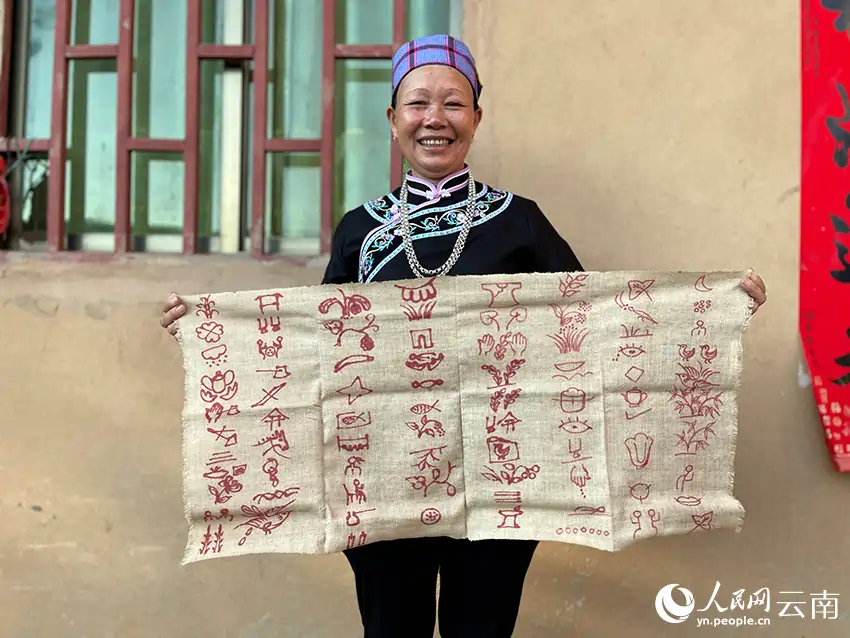
These 81 songs collectively contain 762 lines of poetry. Most verses follow a five-character structure. These songs are arranged following the traditional order of Zhuang antiphonal singing — a call-and-response dialogue between a young man and woman. These songs form an integral part of the Sanyuesan Festival (also called the Zhuang Folk Songs Festival). The following is first Poya Song which is sung in many diplomatic events to show strong minority-identity in China
Although the Poya songs are in Zhuang language(s) but overtime with Sinification, many folk songs were sung in Chinese language as well. In fact the most famous folk singer of China Third-Sister Liu is also of Zhuang heritage (this one song defines entire Zhuang ethnicity today). You can listen to many beautiful Zhuang songs along with lyrics here and if you want to go deeper I strongly recommend watching some videos on Sanyuesan Festival like this to better understand how folk songs are composed.
Tai Phake Opera Tradition
One crucial difference between Western Opera and Tai-Kadai Opera is that understanding every single word is crucial for Tai tradition, whereas in Western Opera most people usually do not even understand a single word due to the musicality.[2] We can say that English Opera tradition is a deviation from common English speech while Tai opera tradition is an enhancement of the same common-day speech. The alignment of tones with melody for comprehension is therefore just as important in Tai Phake tradition as it is to the other Tai groups.
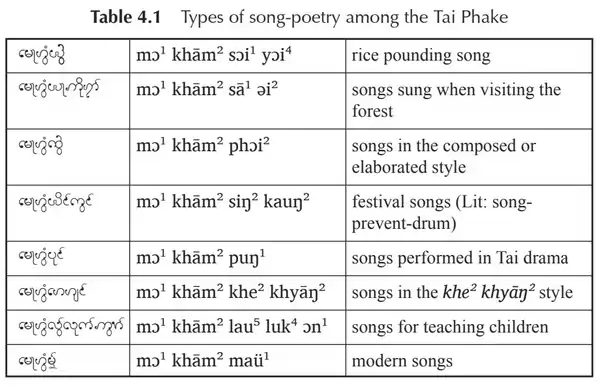
The following video illustrates intonation in traditional Tai Phake songs very well, infact because it is religous prayer, the correct tones matter even more here.
It also appears that they are doing some form of Lamwong here
Shan Recitative Song-Poetry
Now I understand the word 'Shan' is very misleading here as it refers to not just one tribe or ethnicity but rather a collective group
stretching from Southern China to Northeastern India, but for this article context we are using the word Shan for the Tai speaking people in Myanmar
who have formed a common unified Tai identity unlike their counterparts in Assam.
So in Shan, recitative songs particularly of anti-phonal nature are called as ၵႂၢမ်းဝွၵ်းၵၼ် (kwáam wáwk kǎn) or literally
words that cut each other (wáwk can also mean poetry in general). Perhaps an example will suffice here to show how exactly words
cut against each other