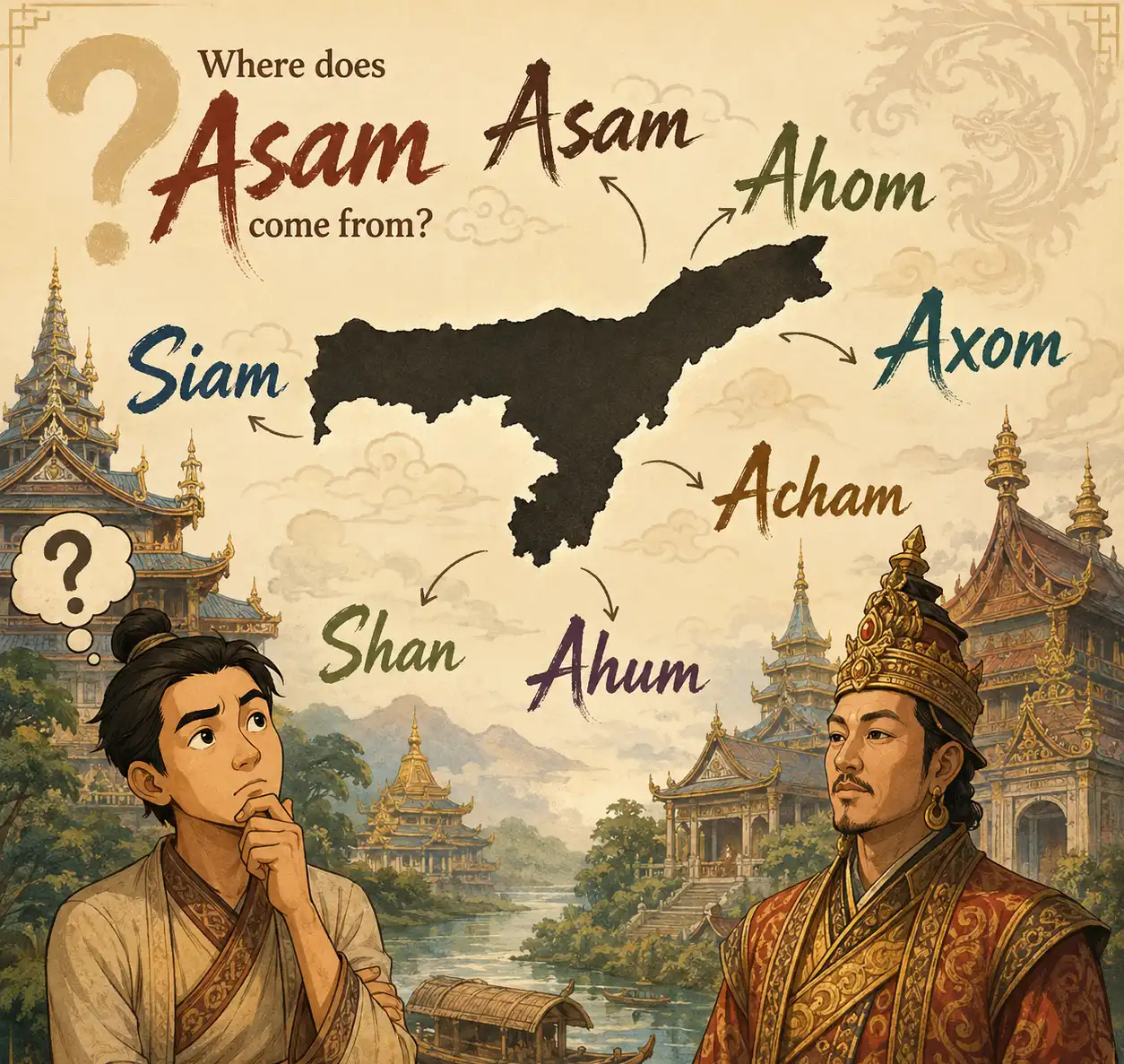
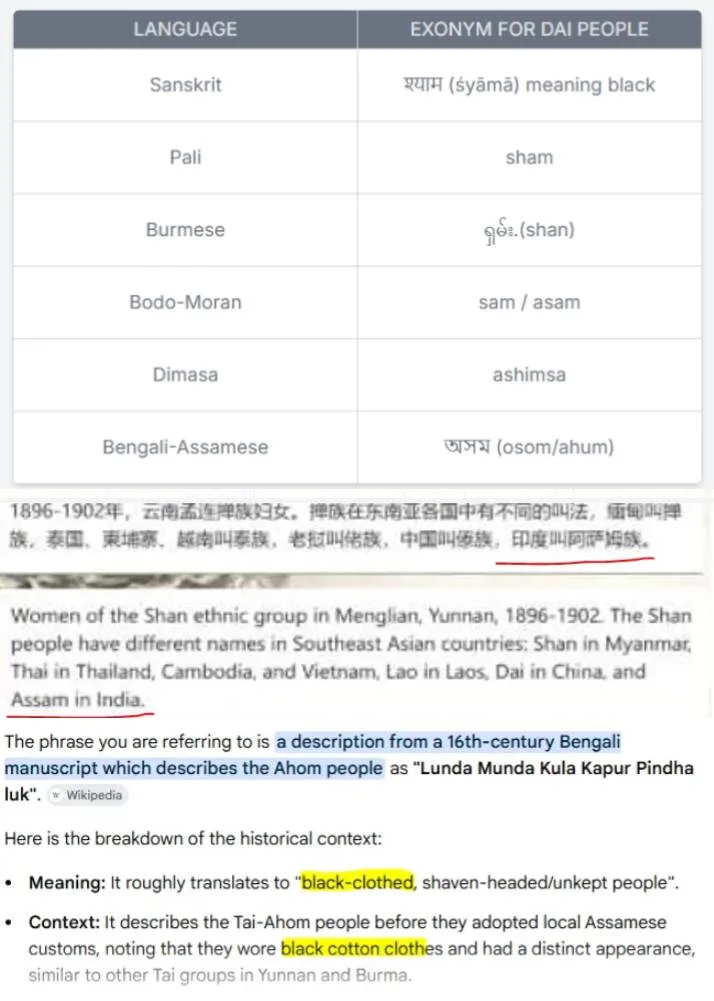
The name Assam has fascinated historians and linguists for centuries, and the accepted scholarship is that the word traces to Ahom people, a Tai-speaking community that entered the Brahmaputra Valley in the 13th century under the leadership of Prince Serkapha. But there is no detailed article explaining the linguistic changes or the origin and meaning behind this word Asam or Ahom. Hence this article !
The Asim or Asamanya Theory
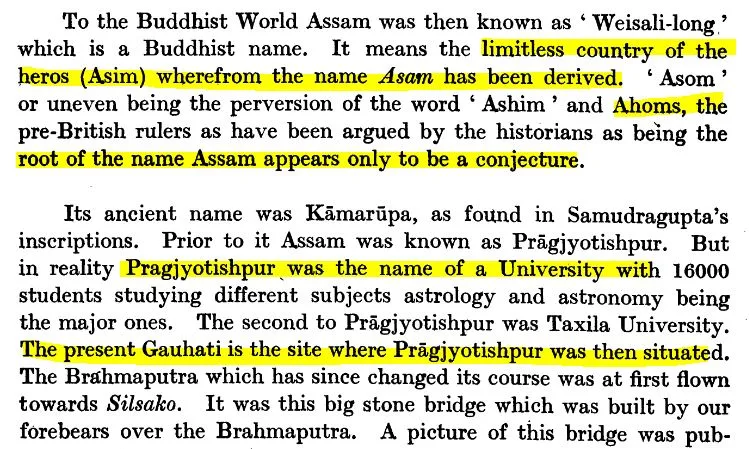
Before, we take accepted scholarship for granted it is important that we counter some Assamese scholars first who still teach in their local history books that the word Asam comes from Sanskrit word 'Asamanaya' meaning uneven as (according to them) Assam is a very uneven land.
One can counter this easily with the fact that no-one ever called Assam as uneven land in anyway (before the British state of Assam came into being which also added surrounding hills). Because, historically Assam only refers to the region ruled by Ahom Kingdom which is the largest cultivable plains region within the Brahmaputra Basin (spanning Southern China, NE India and Bangladesh). So the visible evidence here is that Assam is not an uneven land in the first place. So this forceful translation of Asam as asamanaya won't work. And same goes for the Asim theory where the author even went on to discredit established scholarship position as mere conjecture while positioning his own theory without a shred of evidence.
YC Talukdar, Proceedings of the Indian History Congress, Vol. 22 (1959), p. 473
It is very interesting for me that Talukdar says nothing on the dates or when exactly did Kamarupa started being called as Ashim. Was it before Ahoms or after Ahoms? Morever is the word Ashim recorded in any literature or is it just a figment of the imagination of Talukdar Sahib? It turns out it is the latter, because the word Asam doesn't occur anywhere before Ahoms. Even though there was already lot of literature coming from the region such as the Charyapadas. And even in the many inscriptions from Gupta Empire and Kamrupa Kingdom the word Asam, Ashim or Asamanya is no where to be found or used for the region.
Hence the undeniable fact remains that Assam is a word that was used after Ahoms established their Kingdom. And as we will learn later, Ahom (Tai) people themselves were called as Asamas !
Meaning of Asam or Ahom
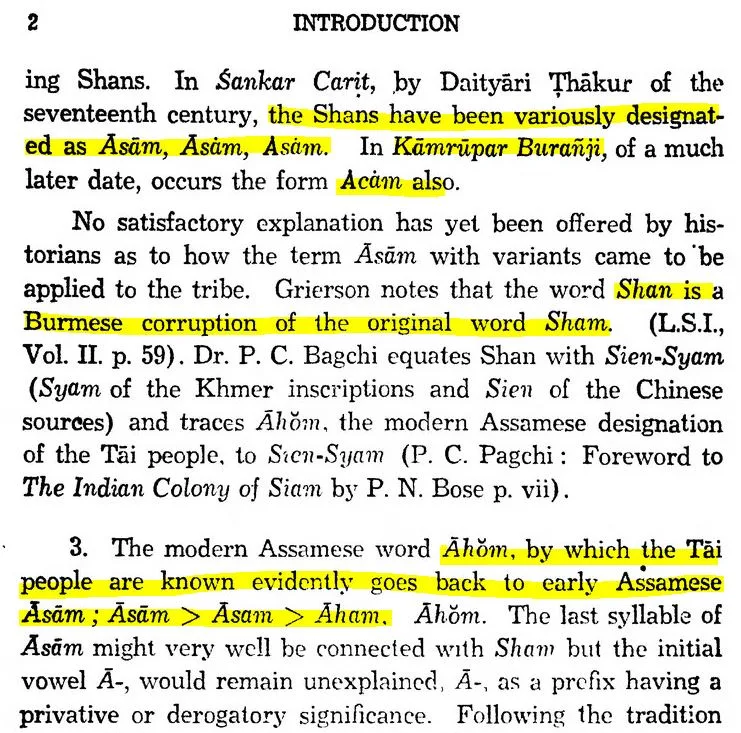
The word Ahom is an exonym, that is the Tai people themselves never self-identified as Ahom. They only called themselves as Tai which means the free people. The word Ahom is actually a non-Tai word, pretty much the same as the word Shan, which is the Burmese word for Tai people.
Banikanta Kakati, Assamese: Its Formation and Development (1941)
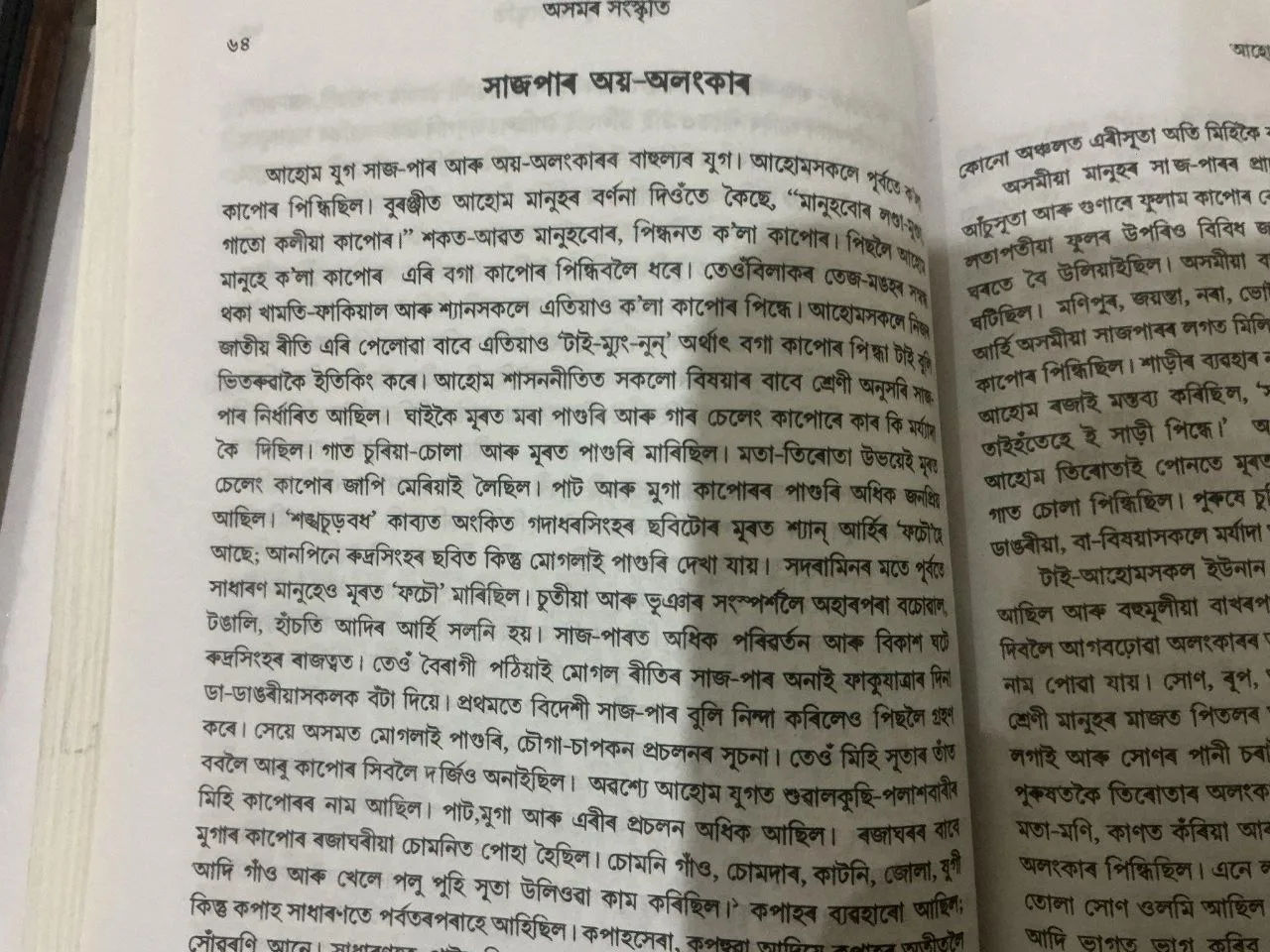
Both these words (Ahom and Shan) comes from the Sanskrit word Shyam which means black, as the Tai people used to wear pure black attire. There is even a 16th century Bengali manuscript which calls Ahom (Tai people) as 'lunda munda kula kapur pindha luk' or undressed people who wear black clothes. Black (shyam) was the original color of Tai clothes, from where Tai people got the exonym Shyam and even today many Phake Aitons and Khamyangs still have Shyam surname. In Burmese this word became Shan to refer to Tai people.
The Dai Ahom people used to wear pure black attire. Ref - Dr. Lila Gogoi, Asamar Sanskriti p. 64 (1982)
The word Assam in particular might come from the Bodo word Hasham, Ha meaning land and Sham meaning the Shan or Tai people, or literally the Land of Tai people. That is the literal meaning of the word.
Etymology of Assam and Ahom
There is a thin possibility that the Dimasa word ashimsa might come from the Sanskrit word ashim (limitless) like Talukdar conjectures but the word is still used explicitly for the Ahom people.
Linguistic Drift: Shan to Ahom
But how did the word Shyam become Shan and Ahom? The answer will sound a bit complicated unless you have a good knowledge of Burmese and Assamese (Kamrupi) Phonology. But I will try to explain it in the most layman way possible.
You see in Assamese the sound 'sha' is often changed to either 'ha' or 'xa.' For example, the Deori word Bisu becomes Bihu, the Dimasa sword seng becomes heng, and the Sanskrit word Akash becomes 'akax.'
So for Asam, in one case it became Aham or Ahom for the people and in another case it became Axam or Axom for the State or Kingdom. Now if you are confused how 'a' became 'o' then it is because unlike Sanskrit which has inherent vowel 'a' [ə], Bengali-Assamese languages actually have inherent vowel of 'o' [ɔ] and so jal becomes jol, and satya becomes hotyo and so on... So how did Asam become Ahom? It is just the way Assamese language works in approximating sounds from other languages.
In fact many times 'o' also becomes 'u' so for example roti becomes ruti, golaghat becomes gulaghat, and in same way in Assamese Ahom actually became Ahum ! But we don't pronounce it that way in English or Dai
Historical use of the word Asam
If I merely give a simple linguistic analysis then people like Talukdar will call it a 'conjecture' and so it is important to show historical use of the word 'Asam' from Sankardev to Mughals.
First let us start from all Mughal records that mention Asam,
Abu'l Fazl – Ain-i-Akbari (c. 1595–1596) : This is the earliest known record of the word Āshām (آشام) used for the Ahom Kingdom by Mughals as well as earliest use of the word outside Assam.
Mirza Nathan – Baharistan-i-Ghaybi (c. 1632–1641) : This text records the Mughal campaigns in Assam during time of Jahangir (such as Battle of Samdhara which resulted in decisive Ahom victory).
Shihabuddin Talish – Tarikh-i-Asham (c. 1662–1663) : Known more popularly as Fathiyyah-i-Ibriyya (loosely translated as Victory with a Warning) the text records Mir Jumla's campaign in Assam
Muhammad Kazim – Alamgirnama (c. 1658–1668) : Historical Chronicle of the first decade of Alamgir Aurangzeb. It mentions one of the last Mughal Campaigns in Assam
An important thing to note is the Mughals call the Ahom Kingdom as Āshām (آشام) and the inhabitants of the Kingdom or Ahom people were called as Āshāmi (آسامی), this word is still used by North Indians today to refer to the Assamese people and is in sync with the Iranian and Central Asian tradition of referring people by their region. But there is also the Hindu tradition where people are referred to by their caste. Which brings us to the Caste Assamese (Brahmin-Kayastha) records on Ahoms
Śaṅkaradeva – Śrīmad Bhāgavata (c. 1481–1493) : This is the earliest known record of the word Asama where it is used for the Ahom people as a group rather than the country
Daityari Thakur – Sankarcharita (early 17th CE) : This work also uses Asama to refer to Tai people
Kamrupar Buranji (late 17th CE) : This work inconsistently uses Asam and even Acham for Ahom people and Ahom Kingdom
Suryya Khari Daibajna – Darrang Rāj Vaṃśabali (c. 1791) : A genealogical chronicle of the Koch Kings. This work also uses the word Asama to refer to the Ahom people
The particular quoted verse in Sankardev's Bhagvata is —
কিৰাত কছাৰী খাচি গাৰো মিৰি যৱন কঙ্ক গোৱাল। অসম মুলুক ধোবা যে তুৰুক কুবাচ ম্লেচ্ছ চণ্ডাল।।৫৩।। আনো পাপী নৰ কৃষ্ণ সেৱকৰ সঙ্গত পৱিত্র হয়। kirāta kachārī khācī gāro miri yavana kaṅka govāla asama maluka dhobā ye turuka kubāca mleccha caṇḍāla āno pāpī nara kṛṣṇa sevakara saṅgata pavitra haya (Bhāgavata 2.2.53-54)The Kirata (Karbi), Kachari, Khasi, Garo, Miri (Mising), Yavana, Kanka, Govala (Keot), Asama (Ahom), Maluka, Dhoba, Turuka (Muslim), Kubasa (Koch), Mleccha, Chandala and all other communities become pure in the company of servants of Krishna
Note ther the word অসম (Asama) here is used for the Ahom community along with other indigenous tribes of Asam and also the beautiful epithets like mleccha (dirty), chandala (wicked) etc. Essentially implying all these listed communities as 'impure' who will become pure only in the company of a servant of Krishna (basically brahmin-kayastha), a separate article shall be dedicated to this cult which call other people as low castes and also the people show the greatness of Mahapurush Sankardev who was so kind as to purify the impure castes like Asama Kachari Khasi Garo Miri etc.
Now we shall look at the European sources of the word
Frans Jansz. van der Heiden – Vervarelyke schip-breuk van 't Oost-Indisch jacht Ter Schelling (c. 1662 - 1675) : Heiden was a European traveller who got shipwrecked off the coast of Bengal, joined the army of Mir Jumla and fought in Assam. In his original written records from1962 he uses the word Assam for the Ahom Kingdom.
Thomas Bowrey (1662) : Mentions the Kingdom of Acham (sic)
Jean-Baptiste Tavernier – Les Six Voyages (1676) : Uses the word Aſem (Assem) for Ahom Kingdom
Niccolao Manucci – Storia do Mogor (1653–1708) : Uses standars spelling Assam for the Ahom Kingdom
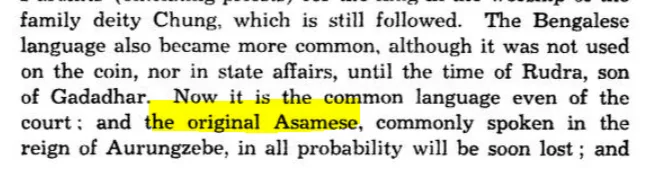
Hamilton Francis – An Account of Assam (1807 - 1814) : The first written record of the word Asamese where it is used for Ahom Language
Here is Heiden's original line where koningrijk van Assam is used for Assam or Ahom Kingdom
Onder het landt van Bengale; verhalende desselfs verongelukken, en den gruwelijken hongers-noot van 32 schip-breukelingen op zeker onbewoont eilant, daer sy van ‘t wrak met een volt aenquamen als ook hoe sy van het selve eilant in Bengale landen, en voorts in ‘t velt-leger van den grooten Mogol, tot in het koningrijk van Assam landewaerts opgevoert zijn
The word Asamese was for the first time used for Ahom Language (Hamilton 1940:7)
Conclusion
There is without a shred of doubt that the word Assam comes from the Ahom people in the same way as France comes from Franks, Russia comes from Rus, England comes from Angles and Bharat (ancient name of India) comes from the Bharata tribe. This doesn't mean that Bharata tribe was the only tribe in India but rather they were so dominant that they got the entire country named after them. Same is true for Ahoms (Tai people) after whom the state of Assam is called. The word Asam is an English corruption of the word Oxom which in turn is an Assamese (Kamrupi) corruption of the word Shan which in turn is the Burmese corruption of the Sanskrit word Shyam (meaning black) as all Tai people used to wear black attire. This same word also was the old toponym for Thailand (Siam).
So Shan Siam Asam they are all just different pronunciations and evolution of the word Shyam which was an exonym for the Tai people. And even today many Tai people have Shyam surname in Assam. There are many more theories given by many Scholars but beyond conjecture two important fact remains that the word Asam though he rejects this explanation on the grounds that the word Asam was never used before the advent of Ahoms (Tai people) and that all early Assamese texts use the word to refer to Tai people and not to the land.
As for how Sham became Asam is that it is a corruption of the Bodo word Ha-Sham with Ha meaning Land and Sham meaning Tai or literally the land of Tai people.

 Learn Ahom