For nearly six centuries, the Ahom Kingdom ruled much of present-day Assam, creating one of the longest-lasting kingdoms in South and South-East Asian history. Although the Ahoms who originally spoke the Ahom language and wrote in the Ahom script, gradually shifted to the Bengali-Assamese language
and started writing in the Bengali-Kamrupi script. This change however was not sudden.
Today, Assam might appear similar to other eastern Indo-Aryan regions like West Bengal and Tripura but there was a time when coins, inscriptions, historical manuscripts, everything were written in Ahom script. So how did Bengali-Kamrupi language of Lower Assam affect the Tai polity of Upper Assam? And why and how the Ahom language and script declined to make rise for the present-day "Assamese" language to became the dominant language of the kingdom? Let us dive into this part of history today
The Original Ahoms
The Ahoms were a Tai speaking people, numbering around 9,000, who came with Prince Serkapha in 1228 AD from present-day Dehong Dai region of Yunnan through Upper Myanmar into the Upper Brahmaputra Valley. They were called Ahom (Shan) because they wore black (သျှမ်း) attire. The original Ahoms continued to speak Tai and follow their Tai tradition well onto early 19th century before their language and identity became extinct cause of Sanskritization.
The Ahoms brought the history-writing tradition for the first time in Assam or even the greater South Asian region and initially, historical manuscripts, royal records, chronicles, rituals, and official correspondence were all written in the Ahom script.
The Ahomisation Process
The Ahoms were a small minority and the indigenous tibeto-burmans (Morans, Borahis, Tsutias, Nagas, Khilimis, Dimasas, etc) were the overwhelming majority. The Ahoms realized the importance of disseminating their culture and thus rapidly began converting the local tribes. The entire Borahi tribe was recorded to be assimilated into Ahom and around 80% of Morans were similarly converted to Ahom.
Unlike the Kamrupi-Assamese scholarship which believes that Ahoms didn't bring any women with them and thus marrying local people adopted their culture, the opposite is true. Ahoms not only brought their women with them (who were skilled warriors) but they also actively disseminated their culture and language among the locals. This is proven by two great warriors Phukawnlung Lachet (Lachit Borphukan) and Thaomernglung Phrasengmerng (Phrasengmerng Borgohain) both of whom were respectively Dimasa and Tsutia in origin. But their family names and their recorded histories show that they were Tai speakers. Morever if Ahoms didn't disseminate their culture and convert the local tribes, then Ahom language should have become extinct in first century of their rule itself.
But because we know that Old Ahom language became extinct only in the last decades of Ahom rule, we can be sure to say that the common Ahom people did everything in their power to protect their language but there were some factors beyond their control such as growing immigration from conquered lands into the mainland or people from Lower Assam coming to Upper Assam and spreading their own language and culture (a certain religous sect members for example).
The Bengalization Process
The early phase of Ahomisation was highly effective when the Ahom polity was still relatively small and centered around present day Chaemun (Sivasagar) region. During this period, the Ahoms maintained a distinct Tai cultural and linguistic identity, supported by a relatively cohesive ruling elite and limited administrative scope.
As long as Ahoms were ruling a small city-state, they had great cultural autonomy and could enforce their own language but as Ahom territory kept expanding to the extremely culturally and linguistically diverse areas, they hit the roadblock to Ahomisation. There were suddenly far more Sino-Tibetan speakers than Tai-Kadai speakers and morever these Sino-Tibetan tribes didn't even speak a single mutually understandable language
Faced with the challenge of governing a large and heterogeneous population, the Ahom state gradually adopted pragmatic administrative and cultural adaptations. Over time, Assamese (which itself evolved through interaction between Indo-Aryan and local languages) became the dominant medium of communication in administration and daily life.
In this process, Brahmanical scholars and scribes from the Kannauj region played an important role in shaping literary and administrative traditions, making their language and their culture the dominant one in entire Assam Valley. This process of cultural shift whereby populations in Assam and other regions like Chittagong Hills, Tripura and Manipur adopted historical Bengali culture and languages is called as Bengalization. And this is why today you see Bengali-Kamrupi signboards in Assam rather than the historical Ahom script.
The Influence of Brahminism
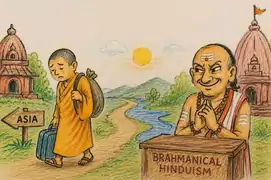
The spread of Brahmanical traditions in the Ahom kingdom played an important role in shaping the cultural and linguistic landscape of Upper Assam. Unlike Lower Assam and the Kamrup region, where Indo-Aryan cultural influence had been established for centuries, Upper Assam came under sustained Brahmanical and Indo-Aryan influence relatively later during the expansion of the Ahom state. The Ahom King gave many important powerful positions to Bengali Brahmins including the control of the Kamakhya temple.
This led to the growing prestige of the Bengali-Assamese language and over time, many communities shifted toward Assamese for administration, trade, and inter-tribe communication. Infact some tribes started looking down on other tribes who didn't speak Assamese (such as Hajongs verus Garos, Ahoms versus Man Tai or the Tsutias vs Jimochayan / Deori)
As a result, several tribal languages like Hajong, Moran, Ahom, Tsutia, and others experienced gradual decline in everyday use. In many cases, this was not due to formal suppression but self-superiority complex of speaking Assamese language or following Brahmanical traditions.
The Old Ahom language itself also gradually declined in daily use only after the Ahom kings adopted Assamese as the court language, particularly from the 17th–18th centuries onward. It survived mainly in ritual contexts and within specialized priestly traditions which too eventually fell out of use 'cause of the preference of Brahmins over traditional Ahom priests.
Prejudice against Non-Aryans
An often ignored topic in Assam Academia is the strong prejudice and discrimination against indigenous non-aryan tribes. Such prejudice exists within the Assamese-speaking Ahom community as well. I shall tell you an anecdote which one Khamyang Girl told me.
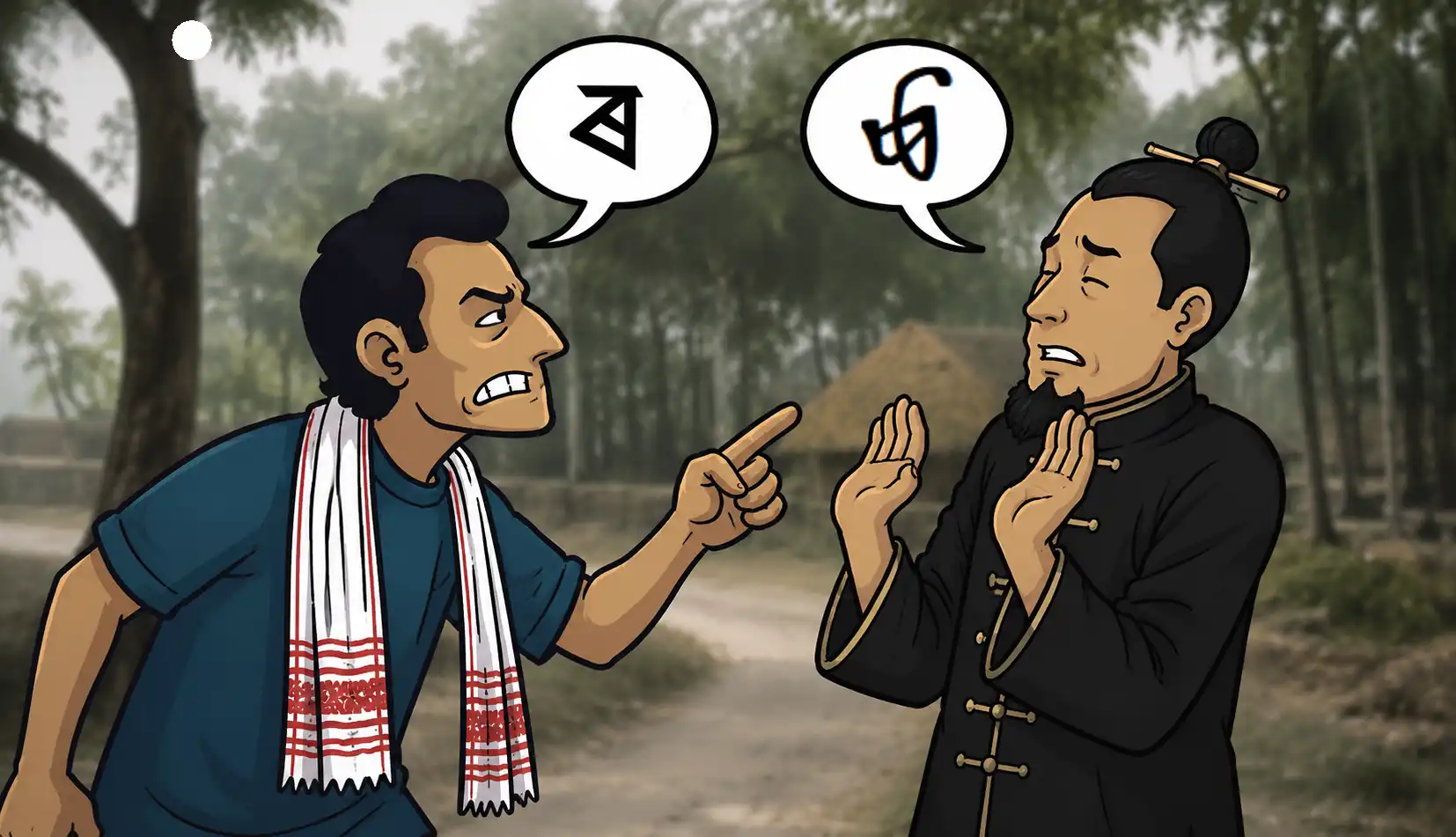
Her Grandfather was a Tai speaker who used to speak in Tai with his sister in school. But other students when they heard them speaking a tribal language used to make fun of them tumi ki naga nki, tumi ki saap khuwa nki (are you Naga? do you eat snake?)
They couldn't even complain to the teacher. Because the Ahom teacher herself used to scold them for speaking Tai - ki chinese language bokisa, asomiat ko - she would say (what chinese language are you speaking? speak in Assamese). After facing so much discrimination from Caste Assamese people and the so-called Ahom people, her grandfather entirely stopped speaking in Tai with her sister and even in his house he only spoke in Asamiya and taught only Asamia to his children. Today not a single Tai Khamyang speaker survives and the language is almost effectively extinct, thanks to the discrimination from Assamese people.
It is very much possible that common Tai speaking Ahoms used to face same discrimination from Assamese speaking Ahoms and because of that the language became dormant and ultimately extinct. This phenomenon can be seen in many tribes like Tsutia, Moran, Hajong, Sonowal, Thengal, all of whom lost their own language because of prejudice against them as well as the superiority complex within their own tribe members for speaking in Assamese and following Hinduism
Revival of Dai Ahom Language
As the Ahom Kingdom expanded, Bengali-Kamrupi language emerged as the most practical language for governance and communication with the kingdom's diverse population. The influence of Hinduism, the flourishing of Assamese literature, and the widespread use of the Bengali-Assamese script further accelerated this transition. But today in the modern English-speaking world the use of Assamese is completely obliterated for the Dai Ahom people.
Today, Ahom Youths are more interested in learning Dai and speaking Dai within their own family rather than promoting Assamese language. Understanding this transition from Ahom to Kamrupi, and back to Ahom provides valuable insight into how languages evolve alongside political, social, and cultural change.
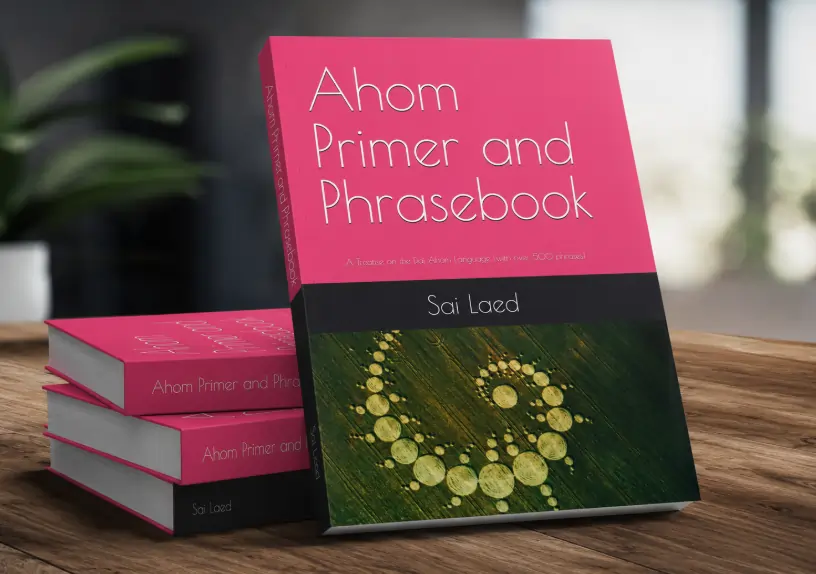
If you are interested in learning Dai Ahom language then you can the buy the ebook or go to the lessons page, we are currently giving 50% discount to all newcomers.

 Learn Ahom