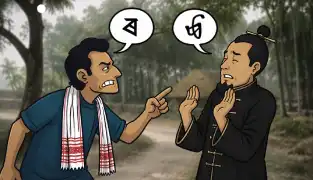
Often wrongly called as Lasit by Assamese people
the word La-chét means 'the seventh one' or literally the number seven in Dai language.
And La is merely an old Ahom affix as seen in Laluk, Langi, Lahon, Lasheng, etc. So the word
Lachét is purely Dai origin showing that no matter whatever the biological roots of Phukawnlung Lachet,
he was culturally an Ahom (Shan). For detailed analysis on historical Ahom names you can check out this article
Although his ethnicity or origins doesn't really change or negate his Dai cultural background, but still
since it is a matter of intense debate online let us look at the background of Lachet and what
written evidence tells us about his origins.
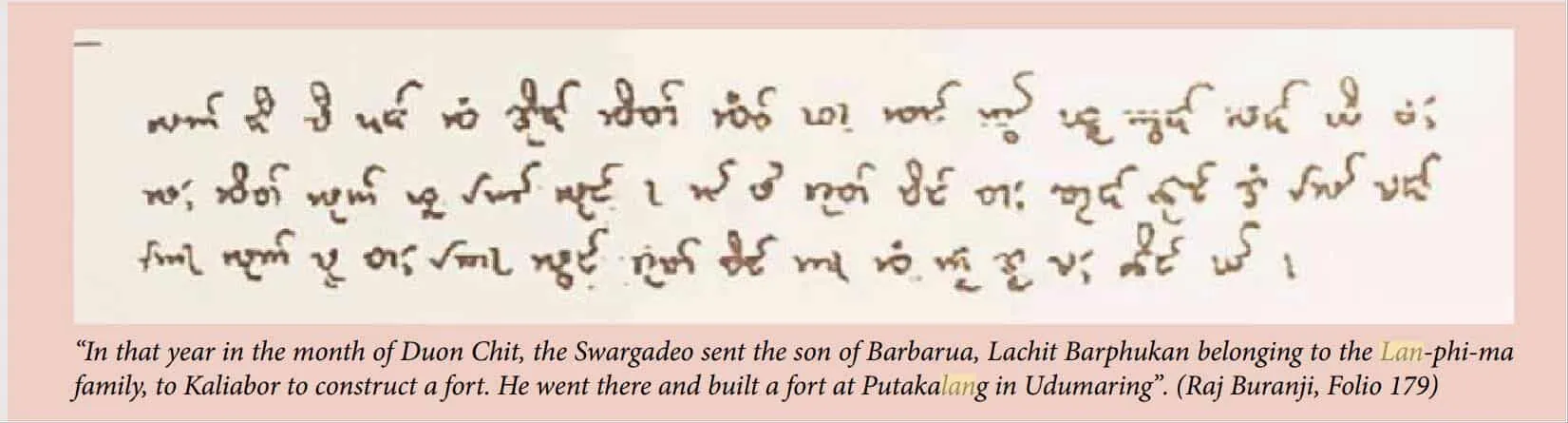
So the following text is from Raj Buranji, Folio 179
lkq nI pI hnq@ cmq$ dEnq cCtq# cw@ fa$ c,[q@ cw@ fU@ konq@ l,nq fI ma la cCtq# lukq@ fU@ ek]@ lu[q /
lak ni pi (lakni year) hān tsâm (on that) dern tsét (seventh month) chāophâ (king) tsāang (employed) tsāo phū kāwn (phukon) laan phima (lanphima)
la tsét (Lachet) lūk (son of) phū kāe lung (barbaruah)
So what is Lanphima here? It is asserted that Lachet belonged to the Lanphima clan. Now
𑜎า𑜃𑜫 (laan) means grandchild but what is Phima? It can
either be horse spirit, dog spirit or it can simply be Dai way of writing Bhima and I believe
we all know where the discussion is going from here. The Dimasa tribe was called by Brahmins as the
sons of Ghatokach who in turn was the son of Bhima. So Lanphima = Grandchildren of Bhima.
That settles the entire debate !
Note how it is written as 'Chao Phukon Lanphima Lachet' and not 'Chao Lachet Lanphima Phukon',
because that's really how we write names in Dai tradition. The family name or clan name always comes first and then your own name.
Check out Dai naming rules for more information
Now some might say that this is just co-incidence but I will strongly argue otherwise because as we all know
that only 9,000 Dai people actually came to Assam so the probability of Lachet being an actual Dai-blood should
have been as low as 1% since the very start.
Dimasa roots Dai Identity
Note that both Lachet and Lanphima are Dai language words. This tells us that the Lanphimas were
probably an early Ahomised clan back when Dimasas still used to rule Upper Assam in 15th century. So Lachet's family
had been Ahom for atleast 200 years and although their surname gave away their identity of an Ahomised family but
the pure Dai names (Lachet, Laluk, Lasheng, Tsireng Phiseng, etc) in their family suggests that they had already
converted to Dai culture and spoke Dai language with each other (no other sufficient explanation for why they had Dai
names otherwise).
Biological roots and Cultural Identity are regarded as completely different thing. For example, what if I told you
there is a theory that the Ava Kings, who were responsible for manor din, are actually Shan (Tai) in origin. It's
just a theory but even if it was otherwise established that Ava Kings were Shan in origin, that doesn't in anyway
negate their Burmese cultural identity, or the fact they fought for expansion of Burmese Empire and not Tai Empire. So that
is one line of thought I would like for people to consider
Rest assured, I will update this article with more information if I find, but request sensitive snowflakes to not make this into Ahom vs Kachari
kinda debate or fight over claiming exclusive right over Phukonlung Lachet
as brave men do not belong to any ethnicity.
But for Hindutva-fascists it is very important to assert that Lachet was not a muslim-hater like them and used to eat beef like
everyone in Ahom Army. So do not do your identity politics in the name of him. Also there is no evidence that he
spoke Assamese language as the court language of Ahom Kingdom at this time was still Dai. So thug groups like
Bir Lachit Sena or other caste organizations who harrass other people should
stop spoiling Lachet's name. Any Ahom-Kachari brotherly fight shouldn't give any reason to other people with their evil
agenda to appropriate the great warrior. That was all for the article.
 Learn Ahom