We need your help
Maintaining this site takes time and resources. If you find our content valuable,
please consider supporting us to help cover server costs.
(Even small amounts matter — 100% transparency in donations).
The question of who banned Sati in India first —the British or the Mughals has recently sparked intense debates on Instagram.
While many people credit the British for ending this inhumane Hindu practice, the actual story is far more complicated
and the efforts of Mughals to ban this practice cannot be ignored
What Was Sati?
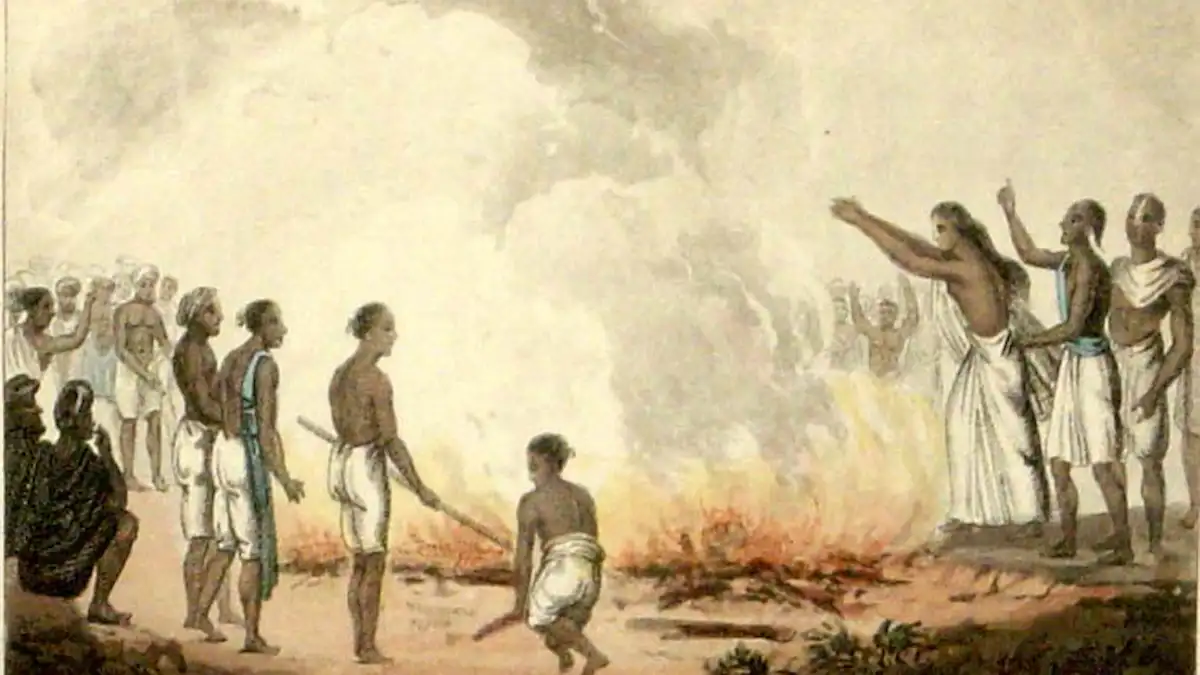
Sati was a funeral practice in which a widow immolated herself on her husband's funeral pyre, as mentioned in
several authoritative Hindu scriptures like Vishnu Smriti, Parashar Smriti, Brihaspati Smriti, Mahabharata etc (Brick 2010) [1]
Mughal Efforts to ban Sati
Unlike the Great Britain which had its own history of persecuting women as witches (a custom which was only outlawed in 18th CE [2]), the Mughals
on the other hand came from a Central Asian, Turco-Mongol heritage where women were highly visible, rode horses, and participated in court affairs.
In both their looks and customs they were more similar to East Asians and present-day Northeast Indians than they were to the Gangetic Indians. As such, the
practice of Sati aghasted them much more than it aghasted the several European travellers who wrote extensively on it.
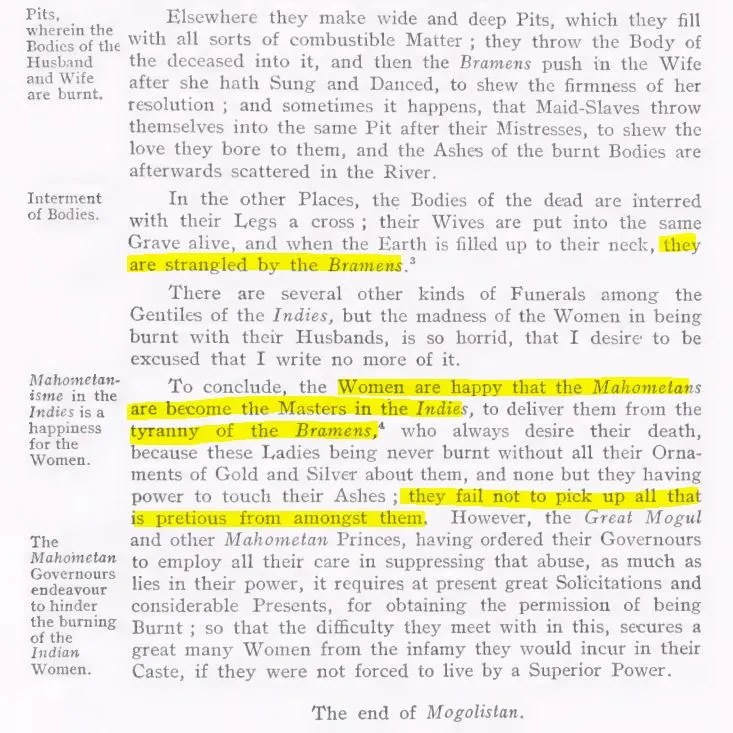
To conclude, the Women are happy
that the Mahometans (Muslims) are become the Masters in the Indies (India), to deliver them from the tyranny of the Bramens (Brahmins)..'[3]Jean De Thévenot, 1661
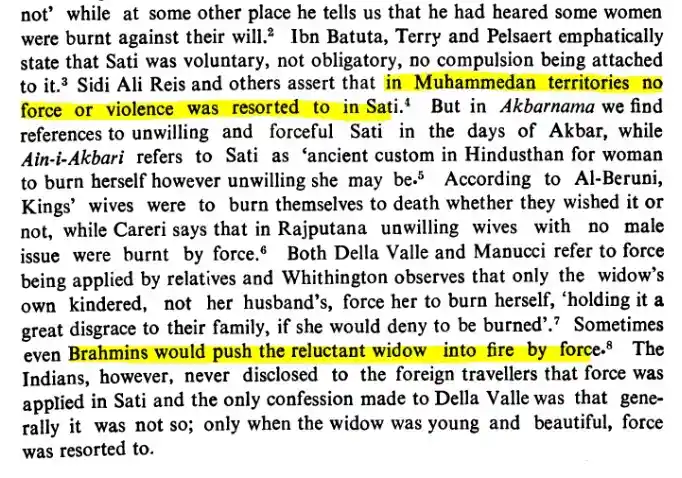
Jean De Thévenot writing on different forms of Sati - 'Bramens' strangling women alive and stealing jewellery from Sati corpsesJean-Baptiste Tavernier (1605–89) on 'Bramins' forcing widow by do Sati by force[4]
We can note two things here in both of these snippets. Brahmins forcing women to do Sati in one way or another and Muslim Rulers trying to
stop them. In fact that is the entire thesis of the article to reinforce a singular point - that the first ruler to ban Sati in India were the
Turco-Mongols not the British. Tughlaqs and Mughals both had origin in Central Asia and had East Asian ancestry and physical features (yes
they didn't look like your Bollywood actors from Mughal-e-Azam or Padmavati). Just to decrease the number of snippets in this article, I will share
this meme to lighten the environment a bit and bring home the important point of the racial distinction of Mughals (Central-East Asian ancestry) from the
Indian Muslims (South Asian ancestry)
Allaudin Khilji is often wrongly represented in Indian-Pakistani Media but he looked more like a Chinese than an Indian or Pakistani
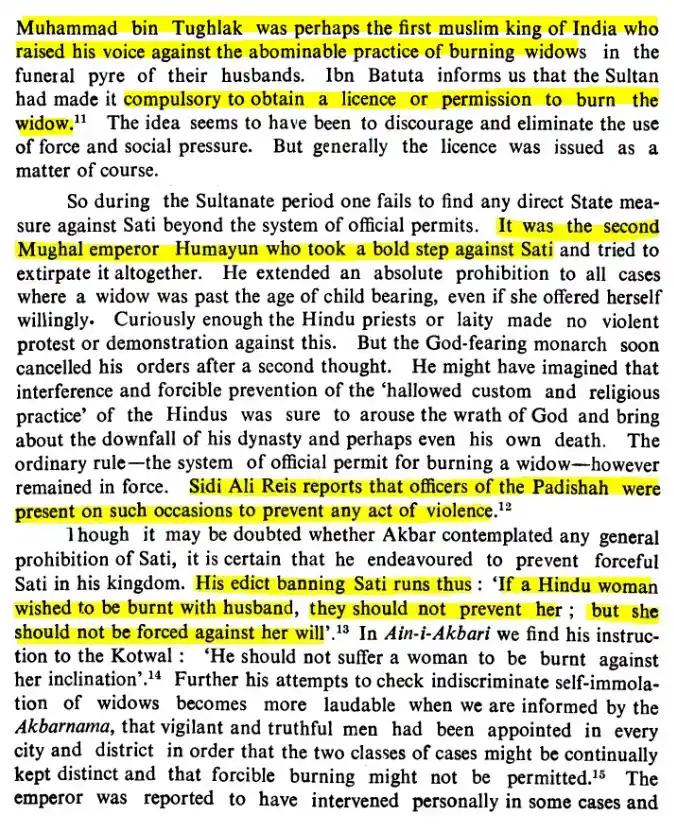
Now if praise be to God we can safely say that it was Muhammad bin Tughlaq (of paternal Central Asian Turkic ancestry) who first banned Sati in India. Humayun,
the second Mughal emperor after Babur also banned Sati for a brief time but reversed changes fearing either the wrath of 'Pagan Gods' or a rebellion or disatisfaction
among ruling Hindu elites for whom it was an important custom and part of their culture.
Tughlaq, Humayun and Akbar banning Sati by varying degrees[4]
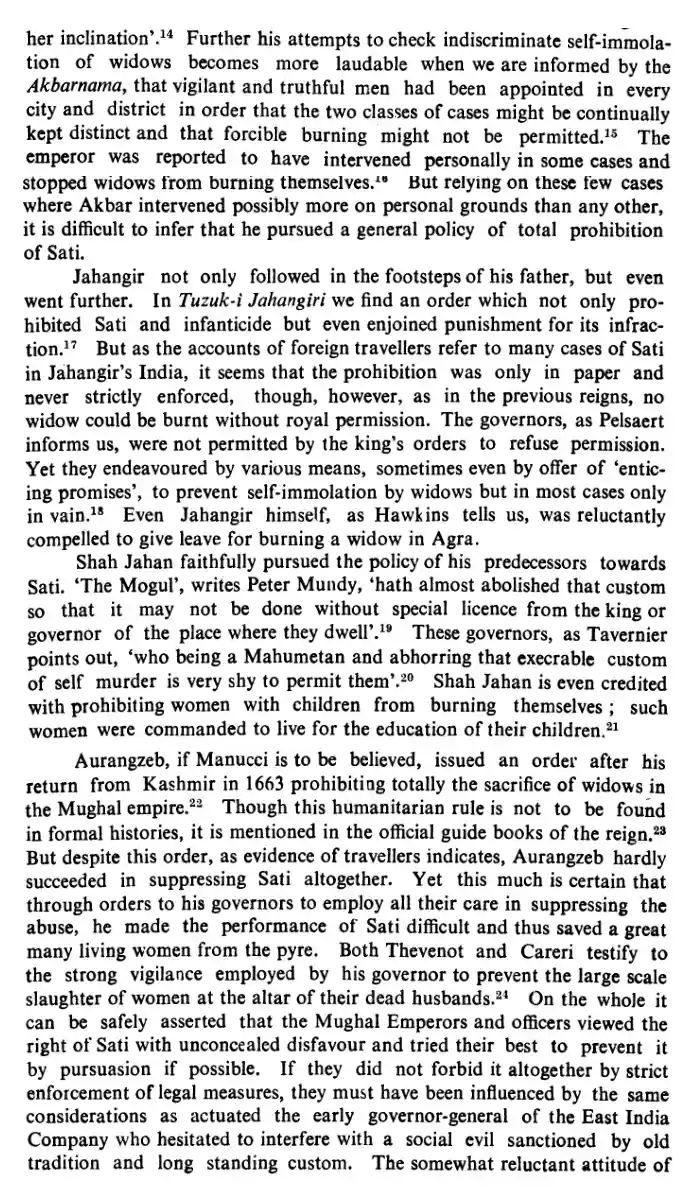
The Great Akbar stopped Sati in some personal cases as recorded in Akbarnama and although he didn't prohibit voluntary Sati on grounds of personal
choice (same reason which modern-day Euthanasia activists give today). His son Jehangir ordered entire banning of both the custom of Sati and female infanticide,
although the execution of his orders still rested on the Hindu nobles particularly the Rajputs who practiced Sati as case of honour killing, and female
infanticide to prevent the number of female children to not have to give dowry. As such both customs were dear to them and part of their
Hindu culture which they saw in threat from the Mughals and refused to obey their injunctions (atleast in my own theory).
Shah Jahan banned Sati for women with children giving the common sense that mothers had to look after their children even more since their father died.
And if Manucci is to be believed then Aurangzeb also issued orders banning the entire custom of Sati, voluntary and involuntary both but just like
Jehangir his overwhelming Hindu majority nobles were very lax about the execution of his orders. Even British couldn't remove Sati completely
as the last known case of Sati was from 1987 - almost 160 years after the law banning Sati was first enacted by William Bentinck in 1829.
Other Mughal Rulers particularly Aurangzeb banning even voluntary Sati (ibid.)
Why Didn't the Mughal Ban Succeed Completely?
Mughals didn't have a solid legal system like the British. They could declare a fatwa - thou shalt not kill, thou shalt not steal
but there was no one to properly oversee even these basic laws as murderous thugs were still commonplace. In the same way even if they
did have a legislation against Sati on paper, there was no ground implementation of these laws, as -
Restrictions varied from province to province.
Local elites often resisted intervention.
Sati continued in some areas despite imperial orders
This doesn't and shouldn't mean that Mughal effort was useless as many French travellers explicitly credited the Mughals for reducing and regulating Sati.
In fact the more closer you were from Mughal Capital (Agra) the less liklier you were to see a case of Sati. But the only problem was
the empire-wide implementation of the ban which never took place, in the same way as we still keep seeing female infanticide and dowry deaths even in 2026.
The Indian society is irreformable but atleast the Mughals tried their best, despite being a racial minority and risking wrath of all Indians.
The rationale behind Sati
This part is complicated because no matter how I see it, you simply cannot rationalize this barbaric custom. One Hindu intellectual named
Swami Vivekananda tried to rationalize Sati as a romantic thing where women were so madly in love with their husbands that they wanted
to be united with them after their death and one day all women did a meeting and built this custom. The truth is that such people are
nothing more than a Charlatan, who make narratives rationalizing or worse glorifying violence against women. Europe stopped glorifying widow-burning
in the 18th century itself, but even today in Rural India you will find Sati Mata or stories Mothers say to their children about Sati Dadi
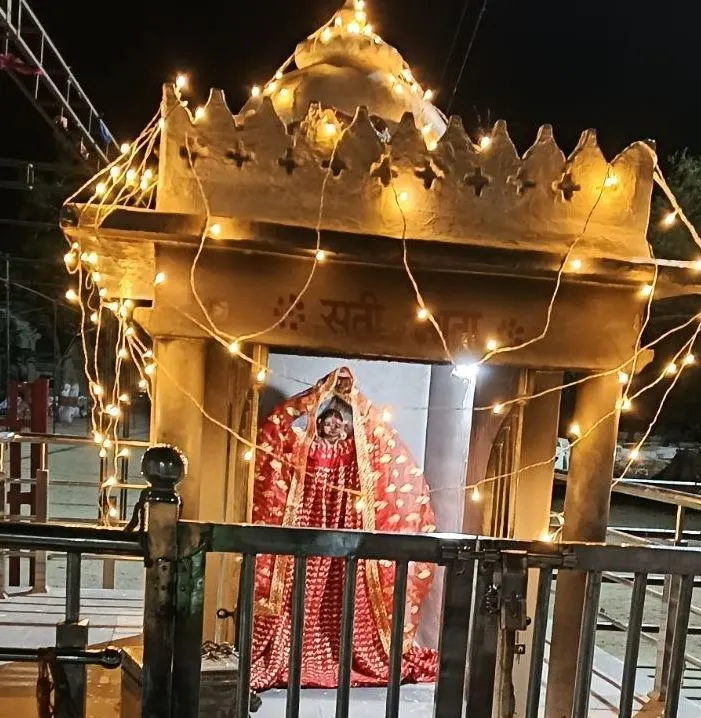
(or the great-grandmother who did Sati). I have personally seen three Sati temples in Rajasthan in just my short visit under one week. I thought one of such temples
to be from Chauhan Dynasty era because it was very close to other old monuments but to my surprise the temple was completely recent, probably twenty-thirty years at most !
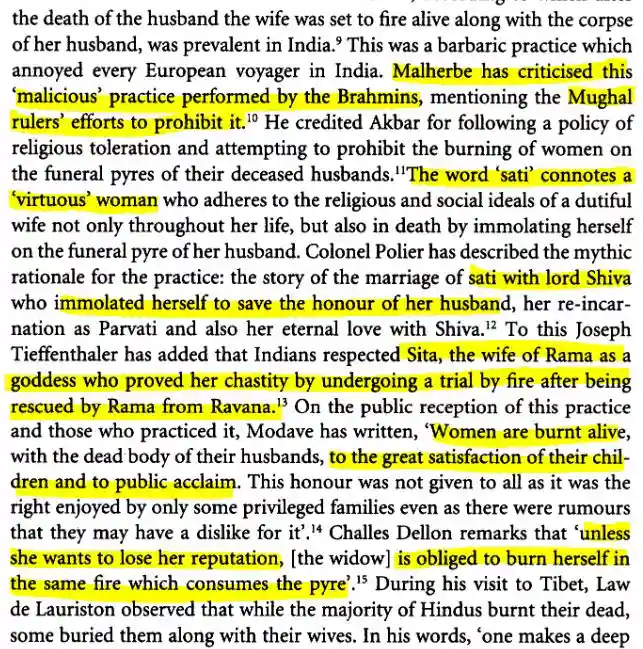
This is because for these Rural Hindu people it is a matter of big pride, infact one reason why women did Sati voluntarily was because they would be bringing
shame by not doing Sati and young maidens knew their life would be worse than hell as a Hindu widow than it would be as a Sati corpse
The societal pressure of being a Sati or a 'virtuous woman'[5]This one is from my gallery but you can find thousands of Sati temples all across Rajasthan Haryana.
Paganism at its best - first they kill you then they worship you
The British Ban of 1829
Advertisement
The most famous and legally decisive action against Sati came during British rule - one that made the career of Raja Ramohun Roy.
For decades the English women had been pressurizing the East India Company to ban Sati just like the Portugese banned it in Goa.
The Company had come to trade on behalf of the British Empire, it had no interest in social reform or missionary activities like the
Portugese had and indeed the British soldiers would generally just look the other way when some Indian crowd would mob-lynch their women
but there were some Europeans who genuinely sympathized with the pathetic condition of Indian women and made personal attempts to save
them. Some even remarried these widows to stop the cycle. So when we talk about British saving Indian women from Brahmin men it shouldn't
be seen as something humiliatory because they did what Indians themselves couldn't.
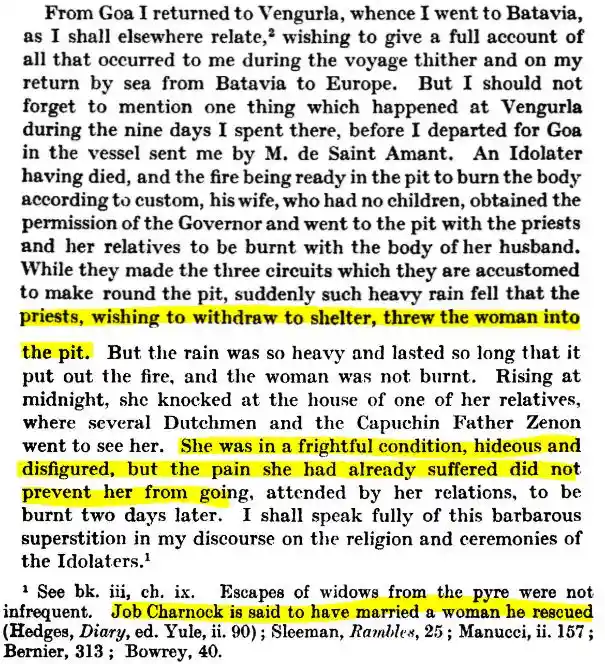
Jean-Baptiste Tavernier giving a very horrible account of Sati[6]
So when some people talk about apparent 'political benefits' of a colonial state to play the white savior game but there was no savior game,
and there were no political benefits only political losses. The average Indian took it as an attack on his culture and tradition and if anything
the 1829 Act threatened Britain with lasting ramifications as Indians started seeing British as anti-Hindu force hell-bent on destroying
beautiful Indian culture of Sati and Devadasi all of which would later blow up in 1857 rebellion after a simple cow meat rumour was
spread by likes of Mohan Pandey.
But the fact remains that, give credit where due, the 1829 act of British is the reason why lakhs of women lives were saved in Bengal which was plagued by
Sati, Child Marriage and Kulin System (although this Sati ban apparently created another problem of rising prostitution
in Bengal as most widows were pushed into prostitution and it wasn't until after the Great Ambedkar drafted the Hindu Code Bill which treated
Hindu widows as fellow human beings for the first time. I strongly suggest the reader to look up more on this as I conclude my article with
similarities between Ahoms and Mughals
Ahom and Mughal Similarities
Ahoms (Dai people) and Mughals (Turco-Mongols) both came from vastly different territories but sharing a common East Asian ancestry, even after
being Indianized in worst possible way never adopted traditions like Sati, Dowry, Female Infanticide etc unlike the
so-called Kshatriyas. Both Ahom and Mughal women enjoyed much higher rights than the common woman in Medieval Era. Many Mughal women
rode horses, could read and write Persian, and even participated in wars as spies. In fact we have records of Mughals employing women warriors as spies
in the famed Saraighat War. And similarly the Ahoms too had women soldiers. Nang Mula who defeated the Turks had an entire contingent of women soldiers -
something relatively unheard of in most places of the world at that time. Similarly there is written accounts of some Ahom court women who could
write Dai script with even their feet (an exxagerated way of writing but you get the point - both Ahom and Mughal women enjoyed higher amount
of rights than Indian women of the same era)
Conclusion
So here is the chronology -
Muhammad bin Tughlaq was first recorded Emperor to ban Sati. Later Mughal Emperors
Humayun, Akbar, Jehangir, Shah Jahan and Aurangzeb all issued their own decrees banning Sati, but Hindu elites didn't obey
and the practice continued
The Portugese officially prohibited the practice of Sati in Goa in 1515. It was temporarily rescinded by Governor Francisco Barreto after pressure from local
Konkani Brahmins but later reinstated by Governor Constantino de Bragança with even stricter criminal penalties.
William Bentick brought the Bengal Sati Regulation (Act), 1829 turning Sati from an ancient Hindu custom to a criminal offense.
It saved many lives but parts of rural India (especially Rajasthan), the act was still flaunted openly
The Congress government brought Commission of Sati (Prevention) Act, 1987 criminalizing not just the act of sati, but also its abetment, and its glorification.
Many the RSS, BJP, and Hindu Mahasabha, protested the law[7] and called Congress government as "anti-Hindu" but the act was enforced very strictly
and even in rural India the custom is no longer found (although the thousands of Sati Mata temples still exist)
But the credit still goes to the one who started the fight first who are the Muslim rulers and particularly Mughals who banned it in their huge territory pan-India.
Because Portugese and British only first banned it in Goa and Bengal, whereas Mughals banned it in pan-India. So the question of who first banned Sati in "India" - the answer is
without a doubt Mughals.
I can write an entire book on this single topic of Sati and infact several hundred books have already been written.
But what I am seeing rn is a modern historical revisionism going on in India as people are openly calling Sati as 'British Propaganda'
First of all I never understood this numbers game. I am quite familiar with Meenakshi Jain's work as well as her participation in
the 2003 historical revisionist work in NCERT during Atal Bihari Vajpayee's government and hence I am quite familiar with all number
games. The British didn't even have a proper number of how many people were killed every year, and yet somehow it is believed that they
had an exact number of the amount of Sati cases every year which Jain believes to be in thousands and not lakhs. It is quite baffling that
if Sati was not widespread then how come every foreign traveller encountered it during their travels. And even if we believe the numbers
were in "few thousands" like the right wing in India claims, how come thousands of women burned alive for no fault of theirs can rationalized
as "few isolated cases." Even one case should'nt happen and rather when anti-glorification of Sati or the Commission of Sati (Prevention) Act, 1987 was brought in 1987 people literally
started protesting, infact even now the law is not properly implemented with thousands of Sati Mata temples all over India. And if you
talk about statistics then there are villages where everyone has a Sati Dadi or some great grandmother who did Sati. Instead of teaching the
next generation about the dark past, the establishment and Caste-Hindu influencers are instead busy hiding it.
In these dark times, I believe it is the duty of every educated Indian citizen to speak out against caste and gendered-violence and
may my article serve as an open letter to the establishment to stop playing with history.
 Learn Ahom