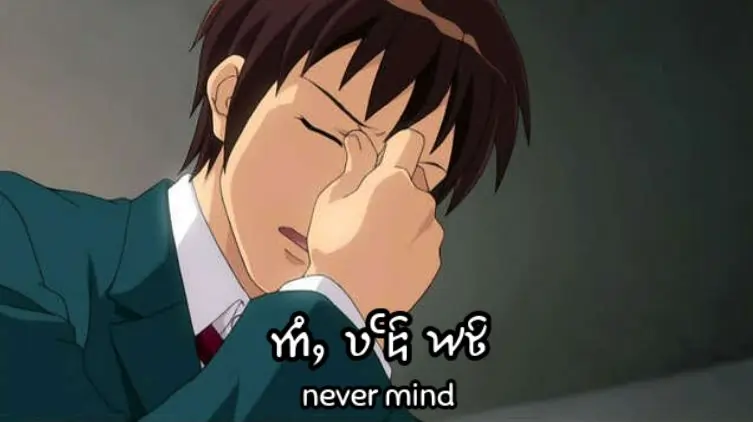
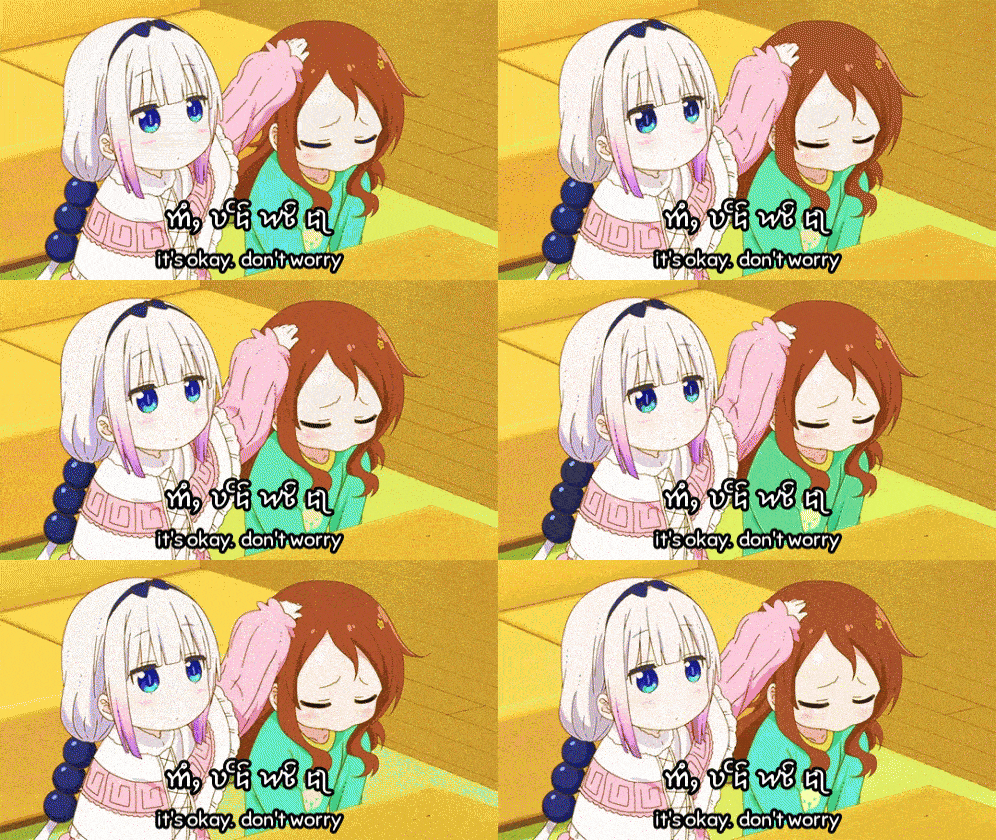
Perhaps one of the most common phrases in Dai Language after mài sung khā, khāwp tsai nā, is àm pen sang
which literally means 'it is nothing' but can be used variety of different ways
Word Breakdown
𑜒𑜉𑜫, àm means not, 𑜆𑜦𑜃𑜫 pen means is/to be,
𑜏𑜂𑜫 sang means anything (it can also mean what in other contexts). So literally
translated it means 'It is nothing' but in practice it can mean several other things like No Problem, No issue, No sweat, Don't worry about it,
Never mind, Forget it, It doesn't hurt, I don't want it among other things. As such it might be confusing for some people and also the fact
that sometimes instead of àm pen sang you might also hear bào pen sang which basically means the same thing
𑜈𑜈𑜫, bào is just a synonym of àm !
So don't get confused if someone says bào pen sang instead of àm pen sang. Both mean the same thing ! But the use of àm pen sang
is a bit more diverse which we will cover in this article today.
Nah! I am not interested
Now this is perhaps a bit interesting because in English we don't say it's nothing to show our disinterest which goes
to show that Tai is not always a literal language as it is made out to be.
Use of Am Pen Sang to Show Disinterest
This is an uncommon - but not rare - use of àm pen sang. But when used in this case it can sound very rude,
so be careful to whom you are speaking with.
Nah! It's fine thank you
It is quite the same way as when we show our disinterest but in this case, with an accompanying smile, to decline help
or favour so that it doesn't sound rude at all
Use of Am Pen Sang to decline unsolicited help or favour
Oh! Leave it
Now when you are frustrated or exhausted of maybe explaining the same thing several times, in which case
you can say àm pen sang to abandon the issue altogether and save everyone's time
Use of Am Pen Sang to abandon some issue
You are welcome
This one people keep asking me how to reply to 'thank you' in Dai Ahom. So you can just say àm pen sang here to mean
No problem, No sweat, No biggie, You are welcome, etc.
Use of Am Pen Sang to reply to thank you
You can also use it to respond to apology to brush it off No issue, It's no big deal, Don't worry about it
Don't worry about it
Finally one of the other uses of àm pen sang is also to console someone. It is similar to giving up on an issue yourself, except that here you are encouraging somebody. We commonly use the na particle here to soften the sentence (you can think it as like saying 'tension mat karo' versus tension mat karo na, that is the use of extra na particle)
Use of Am Pen Sang to console someone
It doesn't matter
One of the most common uses, of àm pen sang is the English way of saying it doesn't matter. For example, it doesn't matter what other people think. You will say an pērn thàang kāw àm pen sang. The use of kāw particle is very important here, which we will devote an entire article to some other day. For now just think of it as a connective particle, which means 'also'. So literally the sentence means '(you) don't love (me) also it doesn't matter'
Use of Am Pen Sang as 'it doesn't matter'
It's nothing
The most literal definition of àm pen sang as we saw in the beginning of the article. It is only slightly different from it doesn't matter, in that you are trying to decrease the gravity of a situation. Maybe hiding your pain, or making something seem more simple than it really is. And again in this example, we use a particle páw - if to make complex sentences.
Use of Am Pen Sang as 'it is nothing'
Similarities with Mai Pen Rai
As you must have noticed, àm pen sang or bào pen sang is just the Dai way of saying ไม่เป็นไร Mai Pen Rai which is one of the most important Thai phrase along with Sabai Sabai.
Although in actual Thai speech you will mostly hear Thai people pronouncing rai as lai, so when they speak fast it almost sounds like 'mai-pəlai.'
The average person might not have so much time but learning Thai will give you an edge and better understanding of Dai grammar and can also
improve your tones and pronounciations as well as give you insight on how Tai speakers actually think because knowing the conventions of when and where
to use a word is equally important in Tai as it is in other languages, and Thai language can give you deep insights of many things that I can
only explain on a surface level.
Moral of the àpum - if you have time do learn Thai as Thai language is to Tai-Kadai but Hindi/Urdu is to Indo-Aryan
It is also a very important South-East Asian language and with upcoming highway project connecting India to Thailand, learning Thai will open more
opportunities to you than ever
Conclusion
I want to keep this article as short as possible so I will conclude it at just this much if you have any doubts you can email me at
admin@learnahom.com. You can also ask questions at LA Forums and
if you have money you can buy the ebook (special discounted price at ₹250/- for now which will also give you access to all the lessons)
We have removed all ads from articles and other important pages but what that also means is a loss of Ad Sense revenue which we hope
we can make up for by ebook sales, and donations. Maintaining this site is a very costly affair
and for even the small amount of support matters.
 Learn Ahom