 Learn Ahom
Most East Asian people cannot differeniate between त and ट, so potty (पॉटी) for poop and poti (पोती) granddaughter both of them will sound the same to their ears. So if someone said ye meri poti hai they would be totally confused if the speaker is talking about his grandaughter or his poop. Similarly there are some phonemes which exist only in Chinese language but not in Hindi Language. For example the j, x, q, sh, zh, ch sounds in Chinese will sound exactly the same to a Hindi speaker and as such, these sounds cannot even be transcribed in Devanagari script for they also have tones.
But we still do know for sure that there are some common sounds in both these languages, but how do we write them? We cannot write them using A-Z or क ख ग , so an entirely new written system have to be created for the specific purpose of transcribing all different speech sounds using phonetics. And turns out someone already did this. The result of this effort is the International Phonetic Alphabet (IPA) which as we will see is the coolest thing ever and also solves our पॉटी vs पोती problem easily.
The first 't' - त is transcribed as voiceless dental plosive - [t̪] and second 't' - ट is transcribed as voiceless retroflex plosive - [ʈ], both of them are a far-cry from the voiceless alveolar plosive [t] or the general English ⟨t⟩ that we are familiar with
Classification of Phonemes
Now since this is a fast-paced course, so instead of going too deep we will just understand a surface level meaning of some words like voiced vs voiceless, dental alveolar retroflex plosive what these all really mean.
Voiced vs Voiceless
The first classification of a phoneme is if they make use of your vocal-cords or not. Try saying 'fa' now don't open your mouth and just hum. Suddenly it becomes 'va'
Another exercise, try saying ChatGPT repeatedly, you will hear it becomes ChatGBT (pee becomes bee) but what really changed? Your tongue is in the same position but still these sounds [p] and [b], [f] and [v] all sound so different. That is the difference between voiced sound and voiceless sound. If you hear vibration when you hum, then it is a voiced sound otherwise it is voiceless sound, where you don't make any use of your vocal chords.
Place of Articulation
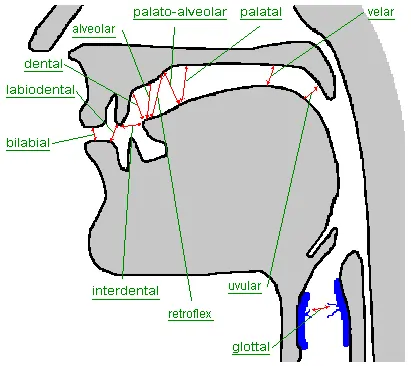
The most important classification of a phoneme is what part of the tongue is used to make that sound, this is what we call as the
place of articulation which is a very technical concept and you don't need to know them as of now. But just know that
whenever we say dental alveolar retroflex etc these are places of articulation which is the second
of a phoneme
Manner of Articulation
Now this is the third and final classification of a phoneme or more particularly a consonant, in what manner was the sound produced. Now try saying pa, ba, ta, da. In all these case you first close your mouth to trap air, and then let it burst out to let the air go. Such consonant sounds are known as plosives. They are also known as stops because you literally stop the air-flow before releasing it.
Try saying any plosive but only keep to the anticipation and you will realize you can't breathe unless you complete the sound, which then makes the air out like a burst or explosion which is why it is called plosive. The other manners of articulation are not so simple and it's fine if you don't really understand them. My whole point was to just explain these things on a surface level for basic linguistics foundation.
Transcription of a Sound
In last lecture, we build a solid foundation of phones vs phonemes as what is being spoken or heard, versus what is being understood. Sometimes the actual temperature outside might be 25°C but because of humidity you might feel 32°C, infact most weather apps also have a classification of the actual recorded temperature along with how it feels like column which is generally more important. In same way there is something called as phonetic transcription vs phonemic transcription, former using phones and latter using phonemes. Former is for the sound that was actually made, and latter for the sound that we felt was made !
Phonetic Transcription
They are written using IPA and enclosed within square brackets, [k], [kʰ], etc to show the exact sound that was made. For eg, phonetic transcription of how the English word "king" is actually spoken might be written as [kʰɪŋ]
Phonemic Transcription
They are also written using IPA and enclosed within virgules, /k/, /kʰ/, etc but they are much more abstract and focus more on capturing the mental image of a sound rather than capturing the actual physical reality of that sound.
For eg, phonemic transcription of the same word "king" will be written as /kɪŋ/
Now please note that abstract doesn't mean arbitrary. You still have to follow the rules of phonological system of that language to correctly differentiate between the sounds. For example, in bit /bɪt/ vs beat /biːt/ or live /lɪv/ vs leave /liːv/. To the English Speakers, /i/ and /ɪ/ sound completely different. So you cannot write /kɪŋ/ as /kiŋ/ but you can write /kɪŋ/ as /kʰɪŋ/ simply because /kʰ/ is considered the allophone of the same phonemes and hence English Phonology treats them as same but in other languages like Hindi they are not the completely different sounds with different meanings just like /i/ and /ɪ/ are different in English.
Also note that ː is the length mark, to distinguish long vowels from short vowels. We will learn more about Consonants and Vowels in next lecture
Graphemic Transcription
This basically refers to the non-IPA orthographic representation of that sound, if it has its own written system or just casual English romanization. They are enclosed within the angular brackets ⟨k⟩, ⟨kh⟩, etc to refer to the particular script in question.
To give a small example, the ⟨aw⟩ sound in Dai Ahom versus the /aw/ sound in IPA both are different, because former is special romanization system for Dai Ahom language, while the latter is the IPA used to transcribe sounds of different languages using single unified script. These brackets help us distinguish where a transcription is localized and where it is IPA.
Conclusion
Now I understand you were probably expecting, I would teach you some different letters of IPA but that is useless. All you have to know is the IPA of your target language that you are learning and learn only those sounds. For example, some people get confused with ⟨er 𑜒𑜢𑜤𑜈𑜫⟩ vowel. It's phonetic transcription is [ɤ] and phonemic transcription will be /ə/ and turns out you are already using this sound in your language, it is the inherent vowel in Hindi and even in a simple English sentence will have lot of schwas /ə/ in it, like
Graphemic ⟨will you eat a banana⟩
Phonemic /wɪl ju iːt ə bəˈnænə/
Phonetic (one realization) [wɪɫ juː ˈiːɾ‿ə bəˈnænə]
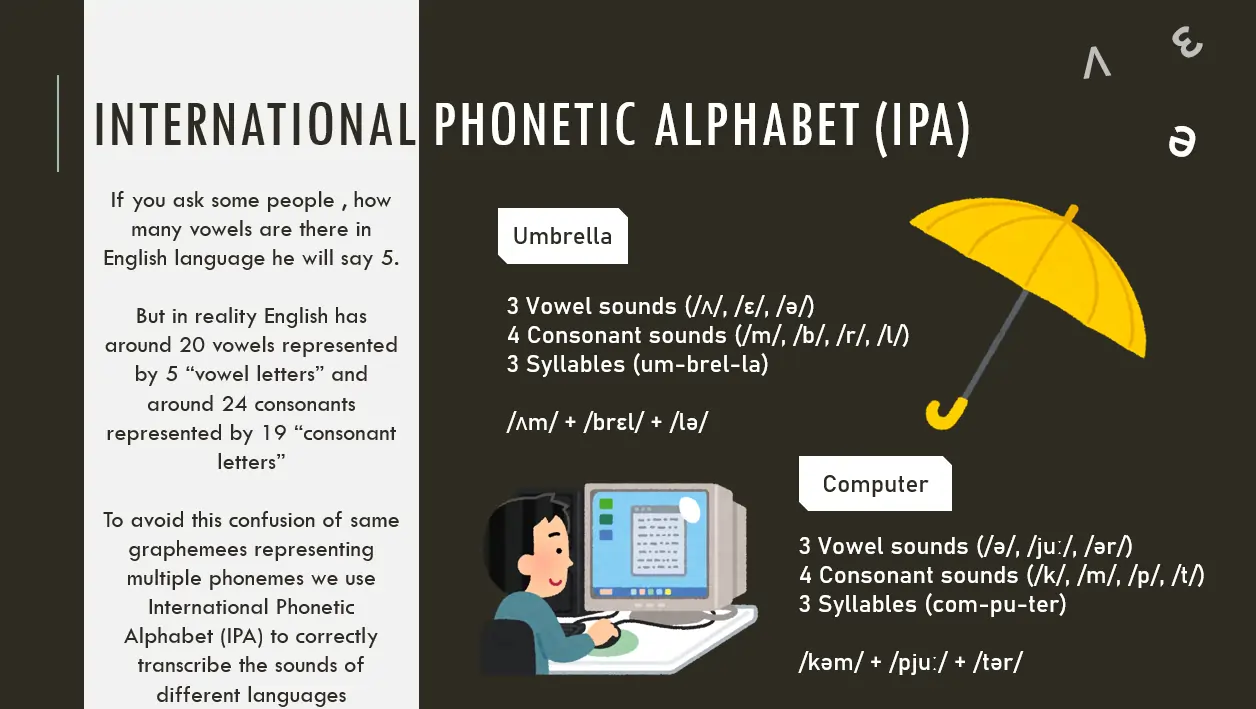
In any language study, IPA will be your most helpful tool in as much as you learn to correctly transcribe the sounds in your brain
Exercise
You must be logged in to attempt this quiz. Login