 Learn Ahom
There are two kinds of Languages - Spoken Languages, where ideas are transmitted through sounds and Sign Languages where ideas are transmitted through signs or gestures. The study of these sounds in any spoken language is further divided into phonology, and phonetics.
Speaking in Layman Terms, our brain doesn't quite understand any language. It doesn't speak in English to communicate with the rest of the body and yet how is it that when English sound waves enter the brain it deduces the meaning in a fraction of a second. The study of the physical properties of these sounds, is phonetics while phonology studies how sounds function in a language and how speakers mentally organize them.
One Definition that I like to give in very simple words, for non-academic purposes, is that Phonetics is the study of phones while Phonology is the study of phonemes
What are phones?
A phone is is the smallest identifiable unit of speech sound as it is physically produced and heard.
They are written using IPA and enclosed within square brackets, eg. [f], [pʰ], and [ʃ] are phones.
What are phonemes?
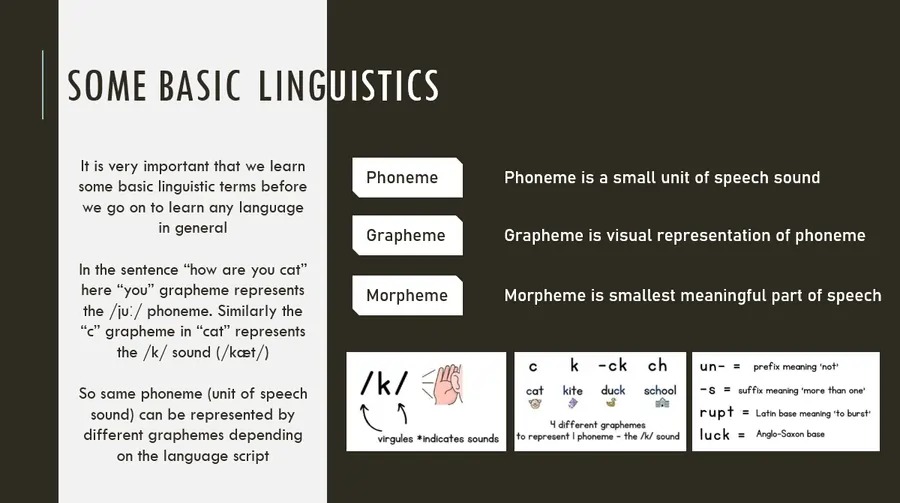
A phone is is the smallest unit of sound perceived by the brain that can change the meaning of a word. They are also usually written in IPA but enclosed within virgules (/f/, /t/, etc) to show that it is approximation of what was understood and not necessarily the exact sound that was made.
For example, the 't' sound in stop, top, and water are all different - [t] [tʰ] and [ɾ] respectively, but to an English speaker they all seem like /t/
Similarly the 'f' in face, fish are [ʃ] and [f] but both of them sounds like /f/
In Hindi, you must have learned k, kha, ga, gha etc - Most Asians can't distinguish between these sounds at all. A Japanese or Korean person cannot distinguish between ra and la, a Thai cannot distinguish between ka and ga and you can make all the vulgar English or Hindi jokes out of this. For instance, A Thai person will say dig as dick, and everyone will make fun of him but in his mind he still feels like he is saying dig only.
Now this is they key difference between phone and phoneme - what is being said versus what is being understood. For example every time you say 'f' or 't' it will sound different than before. If we concern ourselves with technicalities all the time then language study will become impossible !
Which is why we use phonemes or abstract identifiers of the smallest unit of speech sound as understood by our brain. And ofc a Chinese brain will understand phonemes differently from an English or Bengali speaker brain, hence we use the IPA to represent these phonemes as closely as possible. Now I will explain IPA in length in the next lecture but for now let's move on to graphemes and morphemes.
What are graphemes?
Language is a basic form of communication but orthography or written system is a technology that is used to map those spoken sounds into written characters. Of these characters, the smallest fundamental unit that represents a phoneme is called a grapheme. And the study of graphemes is called Graphemics
The English word 'chuck' is composed of five letters but only three graphemes, viz. 'ch', 'u', and 'ck' which represent the phonemes /tʃ/, /ʌ/ and /k/ respectively. We will learn more about IPA next lecture but for now the only thing you need to know is that /tʃ/ is one phoneme represented by the grapheme 'ch' and /ʌ/ is one phoneme which is represented by 'u'.
Similarly in Cat, the grapheme 'c' represents the phoneme /k/
In logographic written systems like Chinese, one grapheme usually represents an entire morpheme
What are morphemes?
A phoneme is just the smallest possible speech sound understood by the brain and grapheme is just the smallest written character to represent that smallest speech sound but what about meaning? Or the smallest meaningful part of speech ? That is what we call morpheme and the study of these morphemes is called Morphology
Writing Systems such as Chinese are designed to write morphemes rather than phonemes. Just think if the word "ice cube" was instead represented by two characters %& with % representing 'ice' and & representing 'cube'. So to make a meaningful orthography, you will then need to have people memorize every character for every morpheme so just for basic literacy you will have to memorize thousands of characters. And you might think it is impractical but there are almost 1.5 billion people in the world who literally read and write such a script as the Chinese, which is objectively the most difficult script on planet !
Hopefully for us, Tai script is very easy and morphemes are written through a combination of handful of graphemes. We will cover scripts / written systems in detail in another lecture. But that concludes the first lecture of Basic Linguistics !
Conclusion
Linguistics is a very broad field but usually is divided in following segments
- Phonetics — speech sounds as physical phones
- Phonology — speech sounds as abstract phonemes
- Graphemics — how phonemes can be written as graphemes
- Morphology — word structure and morphemes
- Syntax — sentence structure
- Semantics — meaning
I am giving the most simplistic definitions for the sake of saving time, so hopefully we can move on to exercises !
Exercise
You must be logged in to attempt this quiz. Login