 Learn Ahom
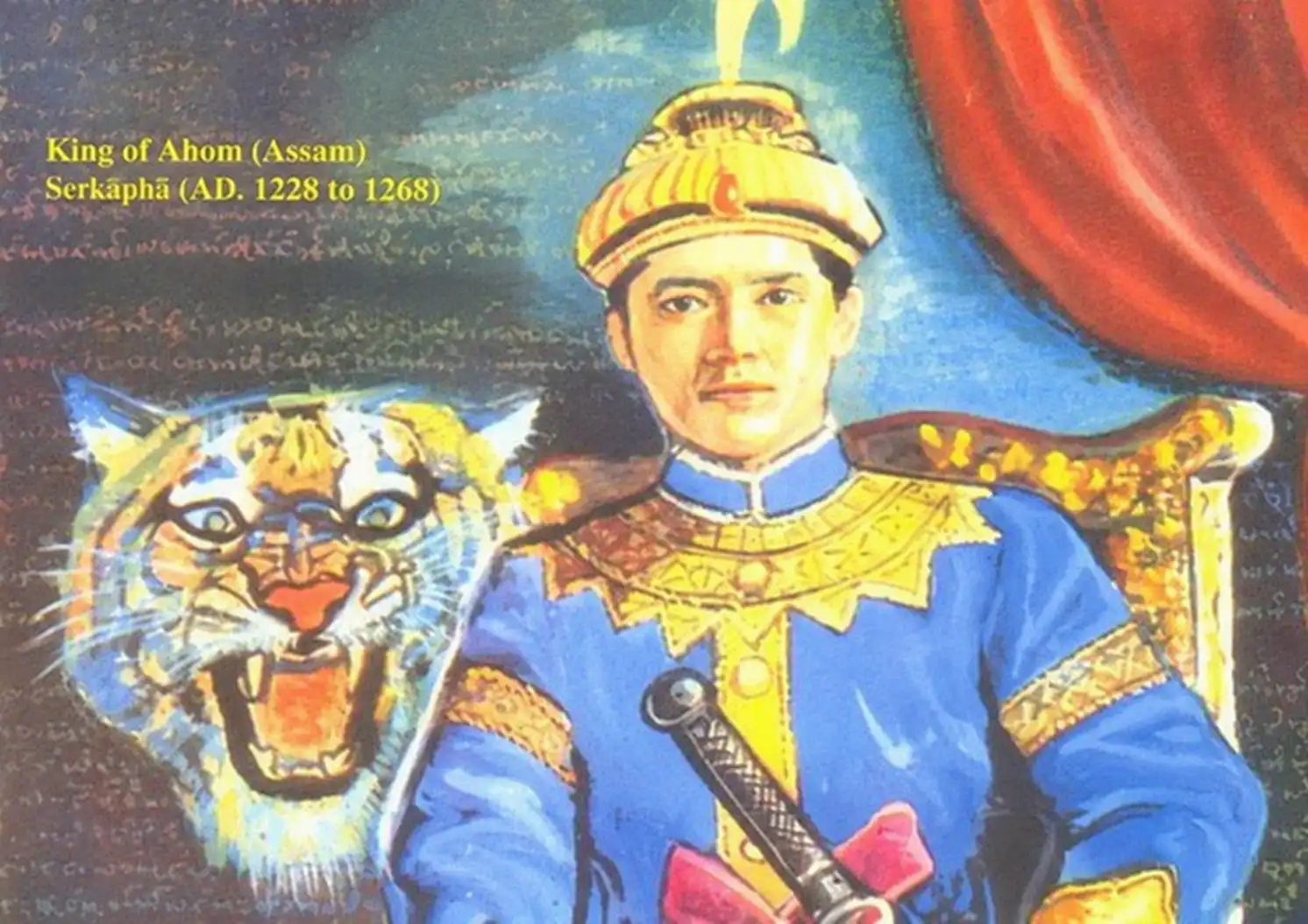
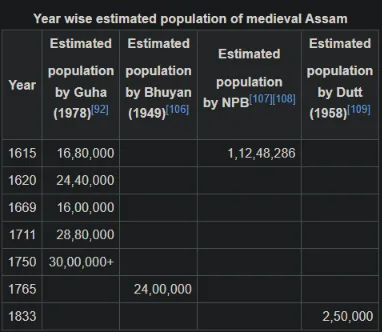
Ahom state ruled over parts of the Brahmaputra Valley for almost 600 years with historians mostly tracing the date of its establishment in the year 1228. The state depended on the logic of mass mobilisation of its subjects to involve in both agricultural labour as well as construction labour activities during peace times and military service during war time. This type form of political organisation was standardised under Momai Tamuli Barbarua in the year 1609 during the reign of Tsaopha Serkerngmerng (Swargadeo Pratap Singha). It enabled the state to efficiently use its population for the war efforts against the impending Turkic danger to the west and the later rebuilding of the country after the wars were over. The system, however, came under strain after a century due to a number of factors such as demographic changes, the rise of Neo-Vaishnavism and the shift in the economic processes in the country.
The Ahom Genesis
In this article, I shall delve upon how the Ahom state at its core was a Sinocratic state that can trace its political structure to the Sinitic concept of statecraft which created a tendency for it to strive for central control. For this, I shall utilise the concept of the Geo-body defined by Thongchai Winichakul in her book, Siam Mapped. The geo-body argues that a country's physical shape on a map is not a natural, ancient fact. Instead, it is a modern artifact produced by human technology, power, and discourse. Medieval South East Asian state's were however defined not by territory but by the people. It was the people and the state's control over them that defined the extent of state power. It was in this logic, that medieval south east Asians states ran on. Since, the discussion here is mainly on the Ahom state in Assam, it is necessary to look into the origins of the Tai polity in the region from where the Tai Ahoms migrated from, namely the area of Northern Myanmar and South Western China.
As per the Ahom chronicles (Buranjis) the Tai Prince Serkapha is described to have migrated from the Kingdom of Maolung (identified as the Merng Mao state based in the Dehong Dai Prefecture of Modern Yunnan, China). Leaving aside the controversy regarding the actual origins of Serkapha and the mismatch of dates of the Ahom migrations and the foundation of Merng Mao, it still safe to assume that the Tai Ahoms under Serkapha came from the wider region of Northern Myanmar and Yunnan China. Here we shall trace the origins of state polity in this particular region.
The Ancient Ailao Kingdom
The area of Northern Myanmar, namely the modern provinces of Kachin and Shan and the Yunnan province of China were under a tribal entity called the Ailao Kingdom. It is variously defined as a tribal confederacy or a full blown monarchical entity. The Ailao kingdom got annexed by the Han dynasty in 76 AD. The period afterwards is shrouded in mystery with different tribal entities in the region holding power while also simultaneously being under Chinese domination. It was in the year 738 AD, a new state called the Nanzhao kingdom was established. Christian Daniels described the Nanzhao state as a Sinitic state, meaning its state structure had direct influence from the Chinese imperial state structures as well as the Confucian ideology. It is quite well known that the Chinese state since the foundations of its imperial structure under Qin Shi Huangdi had a remarkable ability to mobilise its population to accomplish infrastructure at a grand scale. This mobilising ability was also inherited by the Nanzhao state. It is this mobilising ability that enabled the state to control over a vastly multicultural region with an uneven terrain. The most striking example of this mobilisation is the large scale displacements of the tribal populations by the state from less accessible areas to more strategic locations around the walled cities they had established, which worked as the centres of administration of the Nanzhao state. The Nanzhao state is thus the apex of state control over the human body, where the efficiency of the state is measured by how affectively it can control its populace.
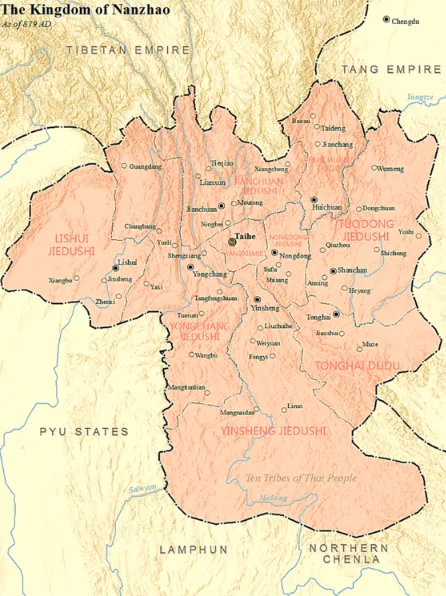
It is to such a model that the Ahom state can trace its genesis to. One of the most obvious similarities of Nanzhao with the Ahom state structure is the division of the populace under a hierarchy of officials. Unlike the Ahom or later Tai systems, where a single subject made one unit, in the Nanzhao state a unit was denoted by a household. Nanzhao was succeeded by the Dali Kingdom. While Dali embraced Buddhism and its monarchs also embraced the Dharmic idea of a universal monarch (Chakravartin) and righteous ruler (dharmaraja), the state largely remained Sinocratic in nature and so did its successor, the Tai origin Merng Mao state. While as per recent historians, neither Nanzhao nor Dali had a Tai ruling class, they still had several Tai feudatories under their control. If we are to go by the traditional date of the Ahom migration to Assam, Serkapha and his brethren may have migrated from one of these tributaries of the Dali Kingdom as a result of which, its state structure already had considerable degree of Sinitic influence. Thus, based on this chronology, it can be said with confidence that the Tai Ahom state in Assam had Sinocratic origins.
Uniqueness of Ahom Polity
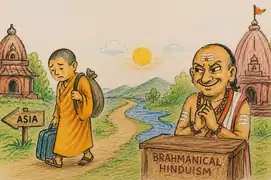
So how does being a Sinocratic state make it different from its other Northeast Indian counterparts? To understand this, let us analyse it with the another very important state of medieval Brahmaputra valley, i.e. the Koch Kingdom. The Koch Kingdom established in 1515 AD was a state built on Brahmanical Hindu structures. It was thus, an Indocratic state, meaning it had a more decentralised feudal nature. It derived its legitimacy from the Brahmanical ideology and Sanskritic state structures prevailed in this kingdom. This can be proven with the fact that unlike other monarchies in the region from this era, who gradually went through a process of Sanskritisation (Ahom Kingdom only had its first properly Hindu king as late as early 18th century), the Koch Kingdom had embraced the Brahmanical religion in the beginning itself. This was due to the Koch core territory being the nucleus of Sanskrit culture in the Brahmaputra valley for almost a thousand years till then. On the virtue of being a Sanskritised Hindu state, the Koch henceforth also follow the Hindu concept of royalty. An example of this is the consensus on dynastic succession. As per Hindu laws of succession, the division of the Kingdom based on dynastic lines can occur if two princes have equal claims. This ideal is represented well in the Great Epic of the Hindus, the Mahabharata, where the Kuru Kingdom was divided into two, one under Dhritarashtra and the other under Yudhisthira, as the latter had a legitimate claim on the throne while another legitimate ruler was sitting on it. As a result of such consensus on kingship, during the reign of the second monarch, Naranarayan itself, the kingdom was divided into two.