 Learn Ahom
In many places in India, students complete a decade of English learning without developing even basic understanding of phonetics. For example, if you ask them what are vowels they will just say a,e,i,o, u ! And as I learned even many principals of government schools in Delhi don't know how to pronounce basic Kindergarden words like 'Lion' - which they say as leon. Bad foundations of phonetics is the main reason why most people cannot even pronounce pronunciation and for a non-inflectional language like Dai Ahom, pronunciation is everything which starts from pronouncing the consonants, vowels, and syllables correctly.
What are consonants?
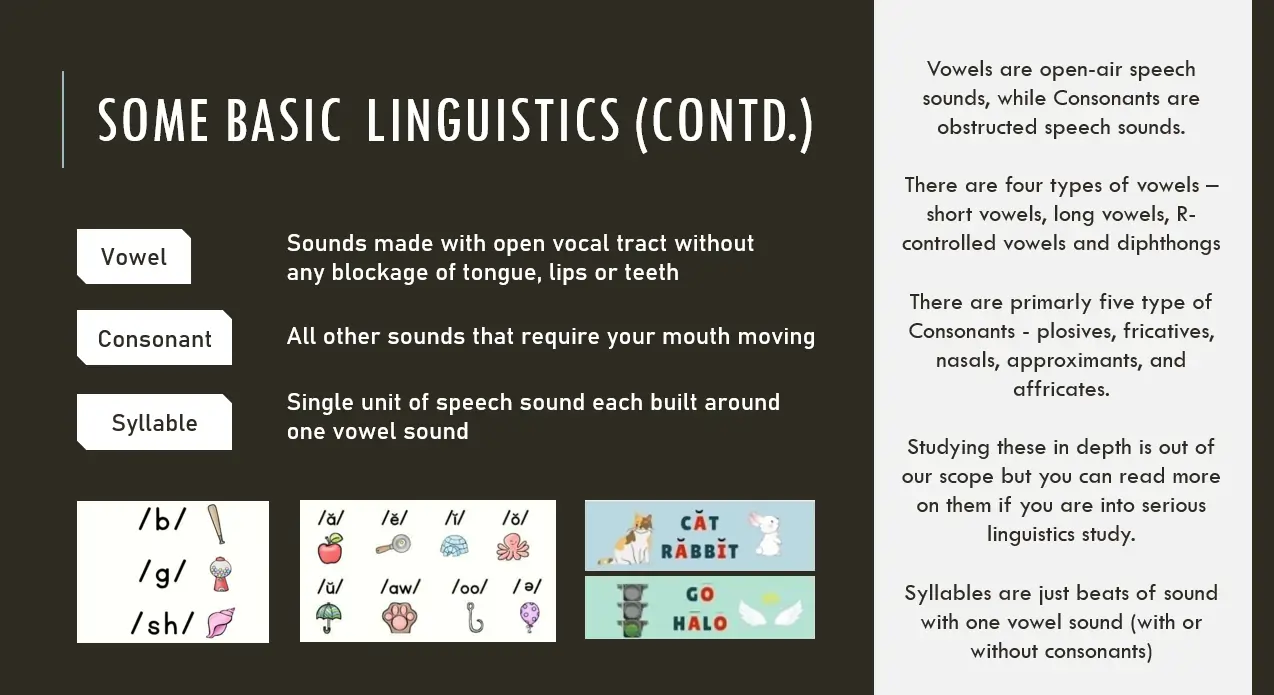
The simple definition of consonants is obstructed speech sounds or phonemes that are formed by obstructing or completely blocking the flow of air from the mouth. If you feel your mouth moving, then it is a consonant
What are vowels?
The very opposite of consonant, i.e. non-obstructed speech sounds which are made with pen vocal tract without any blockage of tongue, lips or teeth are called vowels.
In Kindergarten you might have learned English has five vowels, but those are actually vowel letters and even that is arbitrary because y also functions as a vowel-letter (for 97.5% of the time) such as in words like gymn, myth, happy, etc
So we can actually say that English has 5-6 vowel letters and 15-20 vowel sounds. In a broad sense, there are generally two kinds of vowels
Monophthongs (Pure Vowels)
These are vowel sounds that maintain a single, steady tongue position from start to end. They are further subdivided by vowel length
Short Vowels
Vowels produced with a relatively shorter duration.
Example- bit, pull, full, sit, ship
Long Vowels
Vowels produced with a relatively shorter duration.
Example- beat, pool, fool, seat, sheep
Diphthongs (Gliding Vowels)
These are the combination of two pure vowels.
For example boi /bɔɪ/, oil /ɔɪl/, cow /kaʊ/ , bite /baɪt/, etc.
What are syllables?
Syllables are single unit of speech sound each built around one vowel sound. Just put your hand on your chin and note how many times it moves as you speak a sentence, that many syllables that sentence has !
Ahom is a mono-syllabic language meaning each word is one syllable. Also when we write music, we divide the words in syllables or natural speech beats that we align with the musical beats.
Conclusion
This is a short but still important lesson as consonants and vowels are the basic building block of any language which form syllables which in turn form words which in turn form entire phrases that our brain processes in fraction of a second. So clearing your concepts here is very important.
Exercise
You must be logged in to attempt this quiz. Login