 Learn Ahom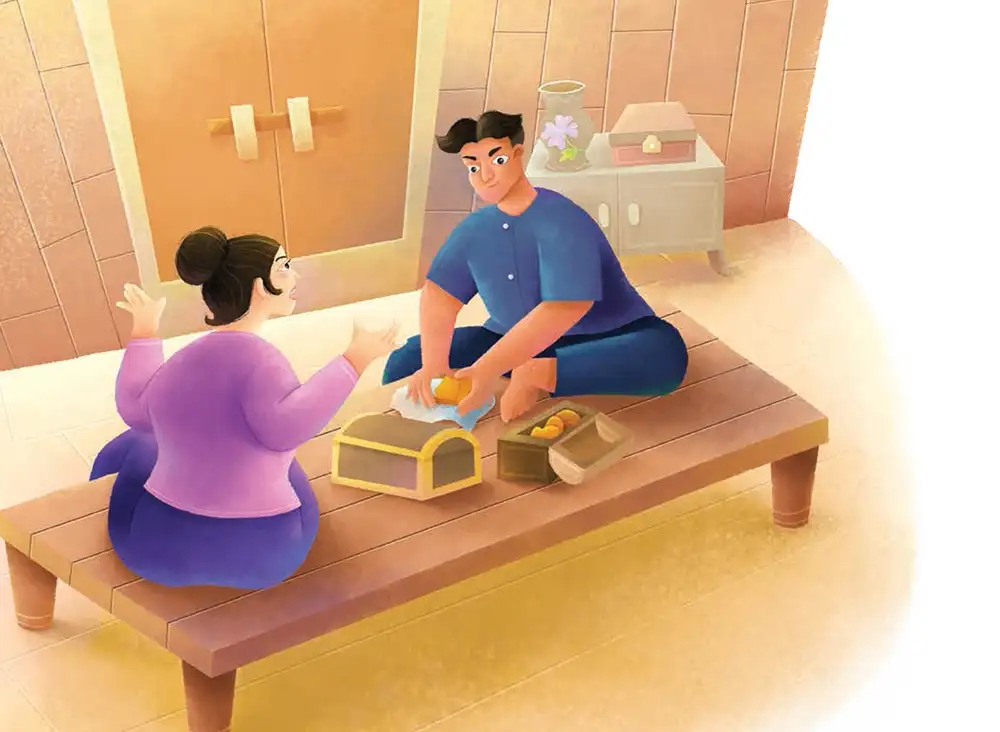
This story is taken from Thai Children's Favorite Stories - Fables, Myths, Legends and Fairy Tales by Marian D. Toth
Long ago in old Ayudhya there lived a man named Nai Hah Tong who dreamed of turning copper into gold. His wife, Nang Song Sai, had little faith in magic. When her husband boasted, “Some day we will be the richest people in Ayudhya,” she listened patiently but when all their money had been used for his experiments, she decided something would have to be done.
“Nai Hah Tong,” she said, “you’ve experimented with copper and a monkey’s paw, copper and a lizard’s tail. You’ve polished copper with a golden stripe of tiger fur, but the copper did not turn into gold. Why don’t you give up and go to work like other men?”
Her husband said, “Mai chai, that is not right. With each experiment my magic has grown stronger.”
“Mai pen rai, never mind, my husband, you must do what you must do,” she answered.
The next day, however, she went home to ask her father for advice. Her wise old father did not seem disturbed. He said, “Pai, go now, and say nothing of this meeting. I have a plan to help your husband.”
Next day Nai Hah Tong received an invitation to dine with his father-in-law. They sat together on the mat-covered floor and the old man said, “My son, since you desire power and a long life, you sit facing east. I seek honor and dignity, so I shall sit facing west.”
“Chai, yes, my father. I always follow the old belief. I never sit facing north when I eat, for I fear the bad luck that would bring, but sometimes I eat facing south because I want people to respect me.” The old man smiled and nodded in agreement.
A servant brought in a large tray bearing bowls of white rice, hot chicken curry, eggs, vegetables, and namprik, a spicy sauce made from beetles and fish paste. Another tray held bowls of fresh water, cloths, and lime scent, for washing, drying, and perfuming the hands. The men ate from the same bowls, using only the fingers of their right hand. They did not speak much while eating because the delicious food demanded their complete attention. The curry was spicy, yet sweet with coconut milk. The rice was fluffy and fresh from the top of the pot. The namprik bit the tongue, but it was good and made the mild coconut milk drink more tasty by contrast.
When the meal was over, Nai Hah Tong felt as content as a baby gibbon sitting upon his mother’s lap.
“Ah, we are lucky to have fish in the water and rice on the land,” he said.
“Chai, my son, but there is more to life than good food. I have asked you to come to see me this evening because I need your help. Like you, my son, I have been looking for a way of turning copper into gold. Now, I know how to do it.”
Nai Hah Tong drew in his breath and made a long, low whistling sound. “Oh, it’s too good to be true! I can’t believe it!” he said.
“Listen carefully, Nai Hah Tong. I have all I need for the miracle except one thing. Because I am an old man, I don’t think I can work hard enough or long enough to get it.”
“Mai pen rai, don’t worry, Father. I will get whatever you need.” Nai Hah Tong
replied.“That is not as easy as you might think, my son. I must have two kilos of soft fuzz gathered from the underside of the banana leaf, and the fuzz must be plucked carefully from your very own banana trees. Furthermore, I know the fuzz will not perform the miracle, unless it comes from a tree planted when magical words are spoken.”
“I can say the magic words and I can raise the bananas. I will collect the two kilos of banana fuzz for you,” said Nai Hah Tong.
The old man smiled and said, “I know you can do this, my son. Because I have faith in you, I will loan you the money to buy the land you will need to raise banana trees.”
The young man bowed low to the elder. In the hearts of each of them there was a feeling of faith and trust.
Nai Hah Tong was determined to prepare his fields in a way which would be most pleasing to all the gods who could help his crops to grow. So he went to his village wat and asked guidance from the monk who knew how to tell the future by looking at the stars. The monk’s bare feet made no sound as he walked from the wat to the open courtyard. His saffron robe glowed in the moonlight. The monk gazed at the glittering stars that lit the sky like fireflies while Nai Hah Tong waited. The only sound was the call of a gecko lizard hiding in a crack of the wall of the wat. He counted the lizard’s croaks: nung, sawng, sam, see, ha, hok, jet. One, two, three, four, five, six, seven.
“Ah, it is a rare sign of good fortune. The gecko calls seven times, bringing good luck.”
The monk returned to his small, bare cell and opened a worn folding book. He said, “Since you were born in the Year of the Ox, you must begin your plowing on Wednesday, the tenth day of the fourth lunar month. Now, do not forget to begin when the sun is midway between the horizon and the highpoint of noon.”
“Chai, chai, yes, yes. I shall do as you say.”
“But first you must build a shrine to the guardian spirit of the field, Phra Phum. Give him an offering of the best rice. Lay it flat on a shining green banana leaf and serve him graciously. At the north corner of your field you must place three triangular white flags. As you mount them on bamboo poles, ask the blessing of the goddess who makes the banana tree rich with yellow fruit. Do not forget to praise the Earth Goddess and do remember to ask Phra Phum’s blessing. Ask these gods to keep hungry locusts and nibbling worms far away from your fields.”
“Is there anything else that I must do?” asked Nai Hah Tong.
“Chai, you will ask your village chieftain to guide your plow three times around the field. When this is done, again honor Phra Phum with the scent of incense and the beauty of flowers plucked by your own hands.”
Nai Hah Tong followed the monk’s suggestions and with the planting of each banana tree he said the special secret words given to him by his father-in-law. His banana trees grew tall, sturdy and heavy with blossoms. Soon he had thousands of firm yellow bananas and a myriad of shiny leaves with a soft layer of fluffy fuzz on the underside. Each morning Nai Hah Tong gave Phra Phum an offering of rice from the top of the pot. Then he carefully collected the soft fuzz from the underside of the banana leaves and stored it in a pottery jar. His wife, Nang Song Sai, offered Phra Phum flowers and incense. Then she collected the beautiful yellow bananas and sold them at the market.
After three lunar years had passed, Nai Hah Tong had half a kilo of banana fuzz. His wife had three pottery jars full of money. Nai Hah Tong was so busy collecting and storing the fuzz that he paid no attention to his wife’s profitable labor. One day Nang Song Sai’s father came to ask if he would have to wait much longer for the two kilos of banana fuzz. “I am an old man. If you don’t get more land, more banana trees, and more banana fuzz, I shall not live to see copper turned into gold.”
“Mai pen rai, don’t worry, Father. I will borrow money to buy more land. Then there shall be more banana trees and I can collect even more banana fuzz,” said Nai Hah Tong. Nai Hah Tong and his wife worked for many years. The moons rose, waxed and waned, and days ran after days, until the time arrived when each had accomplished a goal. Nang Song Sai had collected many jars full of money. Nai Hah Tong had two jars full of banana fuzz. Nai Hah Tong shouted to his wife, “Run, run, and bring your father here. Today he can test his magic. If all goes well, we’ll see copper glow as golden as the sun of Siam.”
When the old man arrived, Nai Hah Tong bowed low before him and gave him the treasured banana fuzz. The old man said: “Arise, my son. Today you will be a rich man.”
Nai Hah Tong trembled nervously. Little rivers of perspiration ran down his face. His fingers shook like banana leaves in the wind. The old man, on the other hand, was not in a hurry. He turned to his daughter and calmly asked, “Have you made any money from the sale of bananas?”
“Oh, yes, chai, chai, my father,” she said.
Nai Hah Tong thought his father-in-law must be out of his mind. When the copper was waiting to be turned into gold, why worry about the sale of a few bananas? Nang Song Sai brought in a tray piled high with golden coins and placed it before her husband.
“Aha!” said her father. “Now, Nai Hah Tong, just look at all this money that has been made by following my directions. My son, I cannot turn copper into gold, but you and my daughter have harvested gold from the sale of your bananas. You cared for the young plants until they became trees producing delicious fruit. Is not that just as great a miracle as turning copper into gold?”
Nai Hah Tong did not answer because he felt like a fool, but he was a very rich fool.
His clever wife knelt before him to show her love and respect. When she arose she said, “My husband, you are a master magician. With the help of the gods you cleared land. You cared for the banana trees with the same loving care we give our sons. You made the gods happy, and they rewarded you with the golden fruit of the banana tree.”
“Mai chai, that is not right, my clever wife. Do not put a story under your arm and walk away with it. It is your father who is the master magician. He has made his honorable daughter and worthless son-in-law the richest people in Ayudhya.”
Nai Hah Tong looked at the meaningless pile of banana fuzz mounted high on the table under the smiling face of his father-in-law. Right there and then, it is said, Nai Hah Tong mixed the banana fuzz with a little water and carefully began to mold it.
“What are you doing?” asked his wife.
“I am making a statue of your father. I hope our sons and our sons’ sons will treasure it as a family heirloom. Each time they look upon it, they will be reminded of my foolishness and your father’s wisdom.”
It is said the statue can be seen in Ayudhya today. It is owned by a wealthy plantation owner who harvests gold, chai … gold bananas.