
 Learn Ahom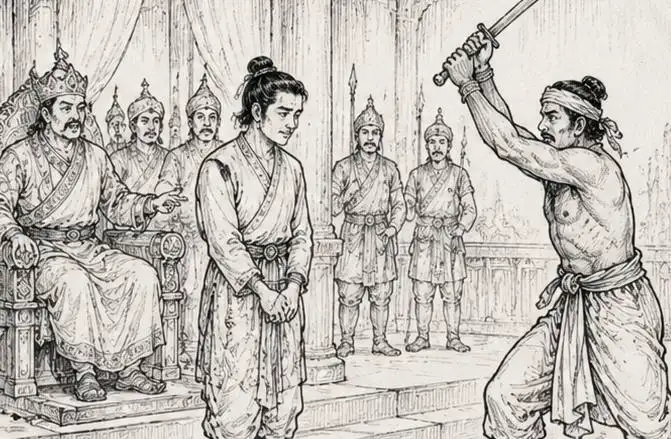
[The story is taken from the B.R. Pearn (19320), Three Shan Legends, Journal of the Burma Research Society (vol. 22, pp. 23–28). It is a common Buddhist story but reproduced here nonetheless
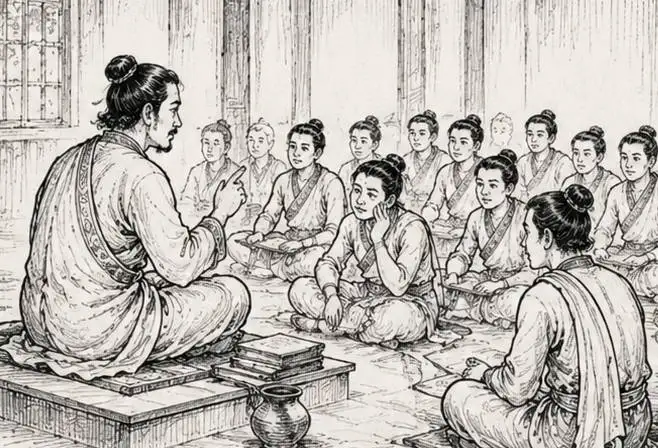
Once there was a very learned man in the town of Benares. Because of his learning he became a teacher. He had a school of his own; he alone taught his pupils and he rose to fame by his cleverness in teaching. It happened that out of his five hundred pupils there was one, and one only, that he could not teach; and even in this case it was not his method of teaching that was at fault. The name of this pupil was Arganee, and he was as dull as an ape in human form. He toiled through his lessons as heavily as a woodcutter through his toiling life. He made no progress in his learning from the time he joined the school to the time for leaving it. One day his teacher sympathetically advised him to try to learn a single word, "Evam-me-sutam," a sacred word taken from Scriptures. Arganee accordingly learnt that word. It was not an easy thing for so dull and witless a lad as Arganee, but after three months studying he was able to pronounce the word as accurately as any wise man. He was so pleased with his success that he said that word before every sentence he spoke. So, after paying respect to his master he took leave of him and went away.
He wandered about the country until one day, when he was making his way through a forest in which he had not before set foot, he came upon a lovely palace. Being half dead with thirst, hunger, and weariness, he sat down under an apple tree which was near a well just by the palace. He satisfied his hunger with the apples, quenched his thirst with the water from the well, and relieved his weariness with a sound slumber. Not long after he fell asleep, he was suddenly awakened by a beautiful, a fairy-like, maiden of about his own age. Now this maiden was the daughter of a lord who was the owner of that castle. Her mother had died about a year before, and therefore only she herself, her aged father, and a single servant, were left to occupy the whole area which surrounded the palace. On that day on which Arganee made his way towards the palace, Hkin Hkin U, for that was the name of the enticing maiden, begged her father to give her permission to seek for herself a learned husband, as she had already entered the threshold of life since her mother died. Her father, without further ado, granted her request. She made a long and wise reasoning with herself the whole day, and had now come out for a walk to enjoy the splendour of the evening. So this is how she saw Arganee.
When Arganee woke up she questioned him about his birth and his occupation and his reason for trespassing on her domain. He answered her questions so satisfactorily that she took him to be a wise man. So she brought Arganee to her palace and discovered her plan to her father. He was very pleased at the successful attempt of his daughter. Therefore Hkin Hkin U and Arganee were married next day. The grandeur of the marriage could not be rivalled by that of any other earthly marriage.
But not many days after their marriage, Hkin Hkin U knew that her husband was no wiser than an ape, and she told him that if he wanted to win her he must go out into the world again to seek for more wisdom. Therefore he went away.
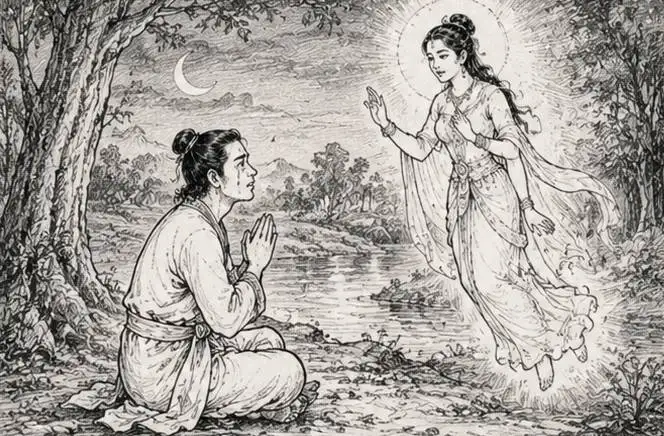
After travelling for eleven days he came to the bank of a river. Being unable to go farther he wept, and prayed to God to help him in his endeavour to lead a wiser life. His prayer was heard by his mother who had died and become a fairy. So she came invisibly to Arganee and told who him she was. She asked him of his troubles, and he made known to her all his wishes. Then he begged her to show him her face. The fairy then said, "My son, from this very instant you will at once become the wisest man in the world, but your second request cannot be granted, lest you should seek to trespass against the lawful consort of human beings." But Arganee cried and wept, saying that he was wise enough not to do so. Then the fairy said, "Dear son, control your mind, and step not a pace towards me, or your will ruin yourself and will die the death of a wretched man." She then showed herself. Arganee, being overcome by desire, tried to embrace his mother, but was forced away by the fairy, who then said, "May you die the death of a wretched man." Then she made her way towards heaven. So Arganee went away sorrowfully, regretting his wicked deed towards his mother. "But what is done cannot be undone," he said to himself, and he continued journey, not the same way as he had come, but towards another country.
When he arrived at this other country he lodged at a shop, and not long after his entrance into the town his fame had become known to every citizen in the town. One day a herald went about the town proclaiming that there would be a contest in drawing at the royal court, and whoever drew the best should become the heir to the throne. So a Brahmin who was expert in drawing, Kala-pyu by name, went to the court, accompanied by Arganee, who was his teacher. But Arganee did not enter the court; he stayed outside. On being commanded to draw the portrait of the Queen, Kala-pyu sat down near the throne. But Arganee, as soon as he heard the voice of the Queen, at once knew the form of her face and every part of her body. As soon as he finished, the Brahmin went home and showed his portrait to his master who had already finished his own drawing and returned home for dinner. Arganee took the portrait which his pupil had drawn and gave him in return his own drawing, saying, "You will be rewarded greatly for that. On seeing this drawing the King was very angry, for the picture was little better than naked; everything that was on the Queen's skin was shown. So the Brahmin was accused of trespassing against the King's will, and so he was sentenced to death. But Kala-pyu said that the portrait was his master's work. Therefore Arganee was sent for. When he arrived before the King he was sentenced to death at once, and was forthwith executed.
Thus was Arganee punished for his evil deed towards his mother. This story teaches us not to be indolent in any enterprise. For though he did lawfully he was killed. Thus his prosperous life was made shegh by the solemn vow of the fairy, his mother.