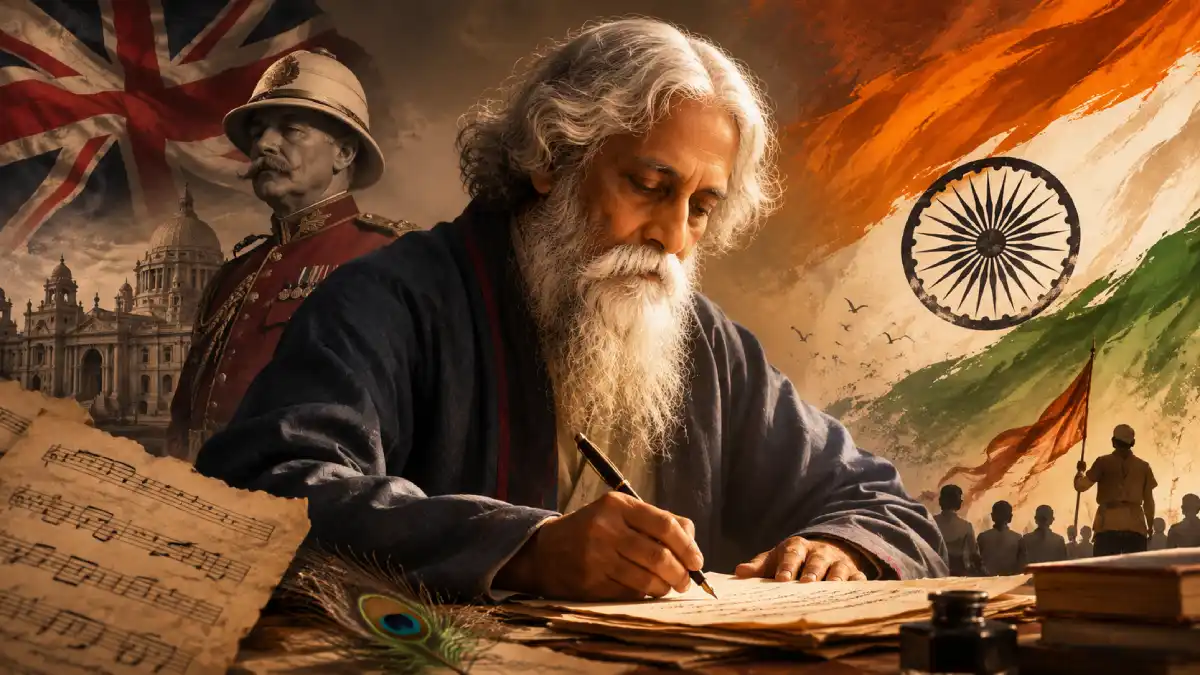
The controversy surrounding Rabindranath Tagore and India’s national anthem has returned to the spotlight after actor Mukesh Khanna questioned whether Jana Gana Mana should continue to be regarded as India’s national anthem as it exalts the British Emperor at the time.
His intervention comes at a particularly sensitive moment, when debates over Vande Mataram, nationalism and the legacy of colonial India are already intensifying. But Khanna’s comments also revive the age-old question : Did Tagore really write Jana Gana Mana to please the British? Here is what we know
History of Jana Gana Mana
Tagore's Jana Gana Mana was first performed in December 27, 1911, during King George V's visit to India. This, as we know, is an undeniable fact.
In a 1937 letter to Pulin Bihari Sen, Tagore explained that a person in the service of the British Crown had asked him to write a song honouring the British Emperor. Tagore said, he was to proclaim the victory of the Bhagya Vidhata—the dispenser or guide of India's destiny.
And this word bharata bhagyavidhata appears in Jana Gana Mana as well — infact it was the original name of the song. So can it be proved that Tagore really wrote Jana Gana Mana for pleasing the British? No, because he never said so explicitly.
His supporters argue that it was a co-incidence of Jana Gana Mana being first performed during King George V's visit to India and the fact that Tagore was asked to write a song praising the Emperor doesn't prove that Jana Gana Mana was that song. They allege that contemporary reports confused or juxtaposed Tagore's song with a separate song welcoming the king and queen, which is a perfectly valid defense.
So in this article we shall go deeper than that, and ask many uncomfortable questions about the history of India's National Anthem as well as the persona of Rabindranath Tagore. I do not hold any personal bias and am merely writing this article to bring forth the truth about Tagore to the masses.
The Original Jana Gana Mana
Many people might not know this but the original name of Jana Gana Mana was not Jana Gana Mana but Bharoto Bhagyo Bidhata or the writer of India's destiny. This is the same word that Tagore used for the British Emperor in his 1937 letter to Pulin Bihari Sen
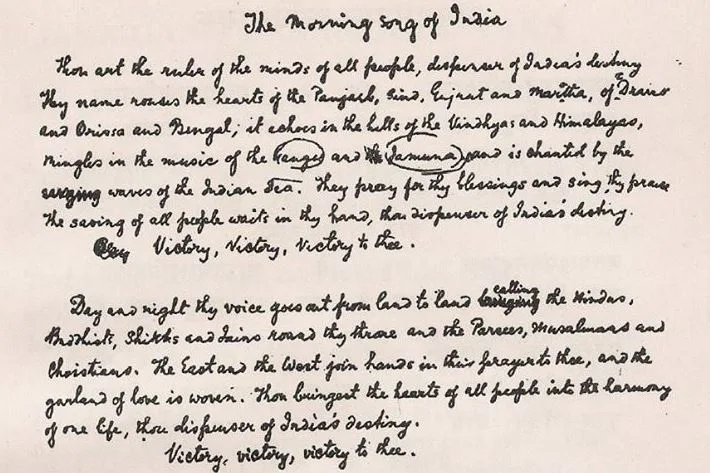
Morning Song of India, Translation of Bharato Bhagyo Vidhata by Rabindra Nath Tagore (1919)
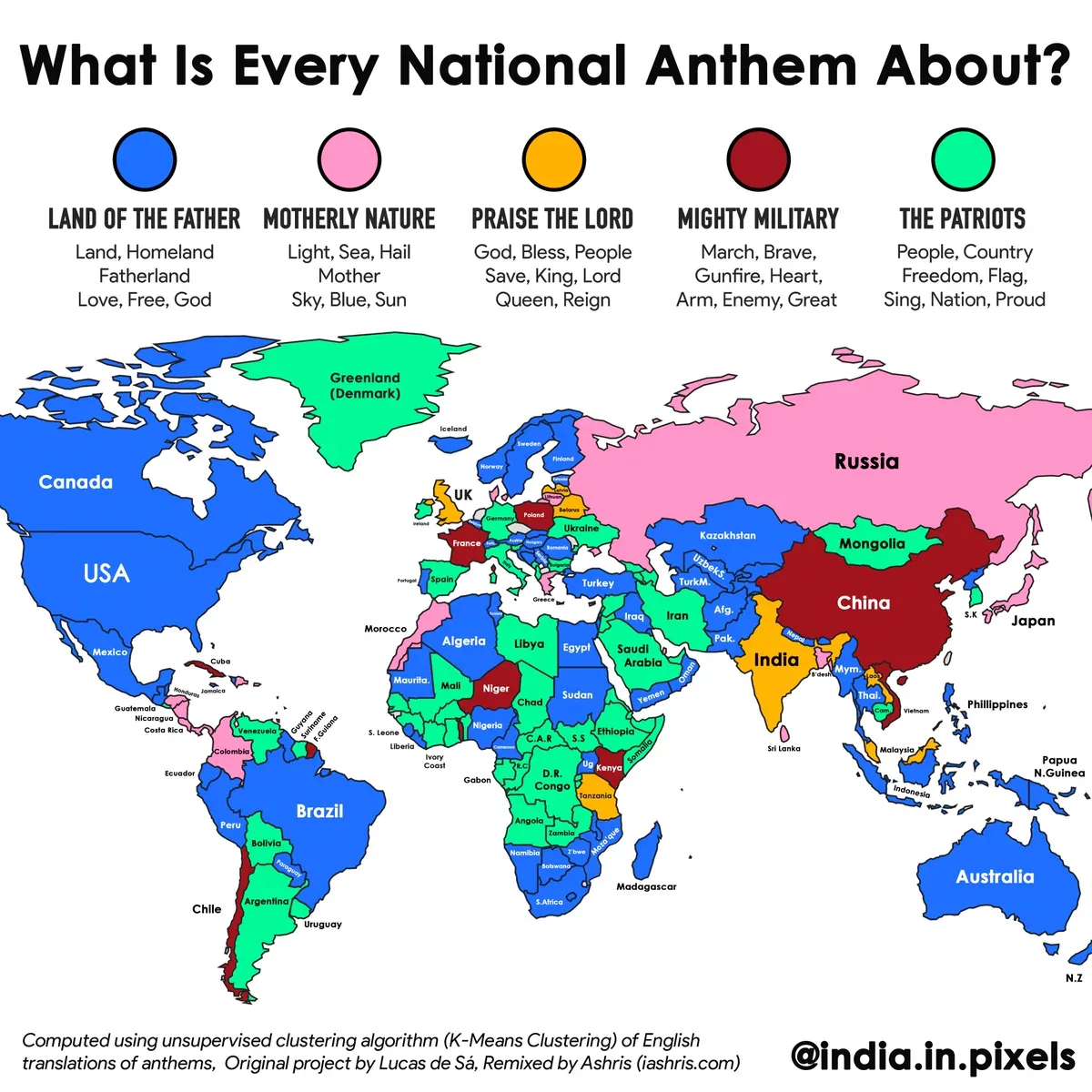
Further if we read the English translation of Bharoto Bhagyo Bidhata by Tagore himself, then we find a strong feeling that this is written to please some King or Queen. In fact, an AI classifier was run on all national anthems of the world and it was found that Indian National Anthem was similar to British National Anthem because they both seem to praise some King or Queen.
Indian National Anthem was found very similar to the British National Anthem as per an unsupervised AI Classifier (source: indiainpixels)
To put it in perspective, there is simply no sense of patriotism or love for motherland in Rabindranath Tagore's Bharoto Bhagyo Bidhata. It lacks a soul in my personal opinion and if you are a Musician you can compare the composition between Pakistani National Anthem and the Indian National Anthem, and you can immediately tell the difference that the Pakistani composition was designed to be the National Anthem whereas Indian composition just happened to be given the national anthem status because they spent several years just to write the constitution, and India was still too poor country for its founders to think about or devote any special attention to national anthem and other fancy things.
The most important viewpoint is perhaps Tagore's views on nationalism itself. Much of the Indian nationalists who today defend his composition might not know that Tagore actually thought nationalism as a disease
Tagore's Views on Nationalism
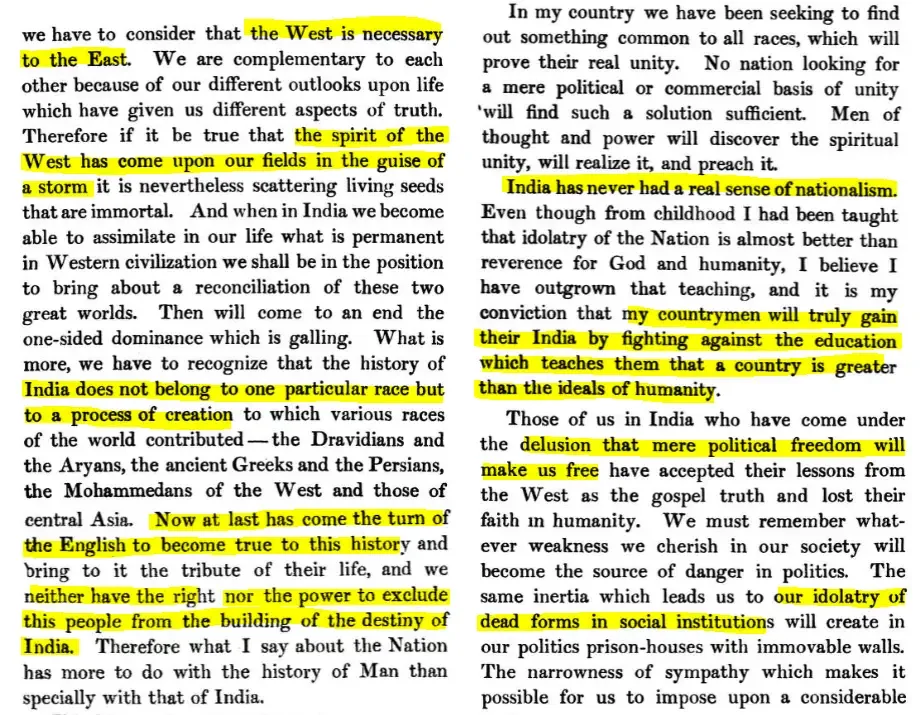
The best primary source for Tagore’s views on nationalism is his 1917 book Nationalism, based on lectures he delivered in the United States and Japan in 1916–17. The book was published 5-6 years after he wrote Bharoto Bhagyo Bidhata allegedly in praise of the British Emperor
Rabindranath Tagore believed that Indians had noa right to exclude the Britishers from building the destiny of India (Nationalism 1917)
Now I want you to note the word destiny here, as used by Tagore in Nationalism 1917 p.16. He says that Indians as people have neither right nor power to exclude the British from building the destiny of India. And the name of the song he wrote, Bharata Bhagya Bidhata and again in Morning Song Of India we find the word
Tagore's Views on Bengali Supremacy
It is a wide-known fact that the baron of Bangla language had little tolerance of other regional languages. In fact, in his Bengali writings Tagore many times referred to Odia and 'Ashomiya' as in inferior dialect to Bengali despite both these languages or "dialects" having far more documented manuscripts than Bengali.
Tagore's Views on Assamese and Odia being inferior dialects of Bengali (ref. Language, Nationalism and Tagore)
Although it might be true that Assamese originated from Old Bengali historically but there is probably over a thousand year old isolation between the two languages particularly Eastern Assamese and Western Bengali so Tagore's statements come across as very narrow-minded and chauvinistic. Later when his daughter married an Assamese person (Lakshminath Bezbaruah) he was reportedly very angry with her.
Furthermore one must never forget that just shortly after coming from London, Tagore married a 10-12 year old girl (Bhabatarini Roy Choudhury). So clearly there are two faces of Tagore which most people don't know about. And this is why when we interpret Jana gana mana we have to see it from the perspective of an opportunist sweet-tooth rather than a nationalist braveheart (as Tagore himself called nationalism as a disease)
Conclusion
Based on linguistic evidence, untrained AI classifier, and Tagore's own consistent phrasing of British writing the destiny of India, we can conclude that the word adhinayaka and bharat bhagya vidhata (the original name of the National Anthem) almost certainly refers to the British Emperor.
Moreover there are many other arguments against National Anthem reportedly the absence of Northeast India (which Tagore probably counted under Bangla) and the presence of Sindh (which is in modern-day Pakistan) which make it unfit for use. So whether Vande Mataram replaces Jana Gana Mana or not is an entirely different matter, but that the current national anthem has problematic origins in praising colonial rule, and doesn't fully represent Modern Indian geography both are undeniable facts.
To counter any facts mentioned in this article, please email admin@learnahom.com

 Learn Ahom