
 Learn Ahom
There are many people who would probably be curious why we use the Daoist symbol for Learn Ahom and what after all is the connection of Daoism with Dai Ahom people. This article will answer those questions, by showing evidence from historical records, ritual practices, linguistic and other cultural sources, how and to what extent the Daoist beliefs influenced early Ahom religious life
Understanding Daoism
Daoism is an ancient Chinese philosophy and spiritual tradition centered on living in harmony with the Dao 道, or “the Way.” Rather than emphasizing strict rules or control, Daoism encourages simplicity, balance, humility, and acceptance of the natural flow of life.
Daoism vs Taoism
Although it is pronounced as 'Tao' but in Pinyin, the letter 'd' is used for the phoneme /t/ while the letter 't' is used for the phoneme /tʰ/ and so for this same reason it is written as 'dao' and similarly ‘tai’ is written as ‘Dai’ because in pinyin, ‘Tai’ will be pronounced as thai to refer to the Thai people.
This is because just like Shan and many other Tai dialects, Chinese doesn't have different [t] and [d] phonemes, so pinyin uses ‘t’ grapheme to represent /tʰ/ and ‘d’ to represent /t/ which is why we write Dai instead of Tai and Dao instead of Tao.
Qi: Energy and Vitality
In Daoism, qi (氣) refers to the vital energy or life-force that flows through all living beings and connects them with the natural world. Daoist thought emphasizes maintaining the free and harmonious flow of qi within the body and in relationship with nature. Practices such as breathing exercises, meditation, and qigong are traditionally associated with cultivating and balancing qi, reflecting the broader Taoist ideal of living in harmony with the natural rhythm of the Dao.
In this article, we shall see many similarities between Daoism and traditional Dai beliefs,
The Dai Ahom Lak-Ni Calendar
Perhaps the biggest evidence of Daoist influence in Early Ahom Society is the very calendar that Ahom people traditionally used – the Lakni Calendar which is based on the East-Asian sexagenary cycle combining 10 Heavenly Stems with 12 Earthly Branches.
The number ten is deeply embedded in Chinese cosmology. The Ten Heavenly Stems were used to organize days and to describe cyclical relationships between yin and yang and the Five Phases (五行).
| Dai Ahom | Chinese | Element | Force | |
|---|---|---|---|---|
| 1 | k,pq! (kàap) | 甲 (jiǎ) | Wood | 陽 (yáng) |
| 2 | l,pq@ (lāap) | 乙 (yǐ) | Wood | 陰 (yīn) |
| 3 | h,j# (háai) | 丙 (bǐng) | Fire | 陽 (yáng) |
| 4 | mE[q# (mérng) | 丁 (dīng) | Fire | 陰 (yīn) |
| 5 | pEkq# (pérk) | 戊 (wù) | Earth | 陽 (yáng) |
| 6 | ktq# (kát) | 己 (jǐ) | Earth | 陰 (yīn) |
| 7 | xUtq# (xót) | 庚 (gēng) | Metal | 陽 (yáng) |
| 8 | rU[q$ (rông) | 辛 (xīn) | Metal | 陰 (yīn) |
| 9 | tw! (tào) | 壬 (rén) | Water | 陽 (yáng) |
| 10 | ka! (kà) | 癸 (guǐ) | Water | 陰 (yīn) |
The 12 Earthly Branches are further linked with Zodiac Animals such as Rat, Ox, Tiger, Rabbit, Dragon, Horse, etc. A familiar example of this system can be seen in the present year 2026 is the Year of the Horse, mâ / 马 as also called so by the Tai Dam people of Vietnam
| Dai Ahom | Chinese | Zodiac | |
|---|---|---|---|
| 1 | c]$ (tsâu) | 子 (zǐ) | Rat |
| 2 | pw$ (pâo) | 丑 (chǒu) | Ox |
| 3 | yI# (yí) | 寅 (yín) | Tiger |
| 4 | mw$ (mâo) | 卯 (mǎo) | Rabbit |
| 5 | sI (si) | 辰 (chén) | Dragon |
| 6 | s]$ (sâu) | 巳 (sì) | Snake |
| 7 | sI [a$ (si ngâ) | 午 (wǔ) | Horse |
| 8 | mUtq! (mòt) | 未 (wèi) | Goat |
| 9 | snq (san) | 申 (shēn) | Monkey |
| 10 | rw$ (râo) | 酉 (yǒu) | Chicken |
| 11 | mCtq$ (mêt) | 戌 (xū) | Dog |
| 12 | k]$ (kâu) | 亥 (hài) | Boar |
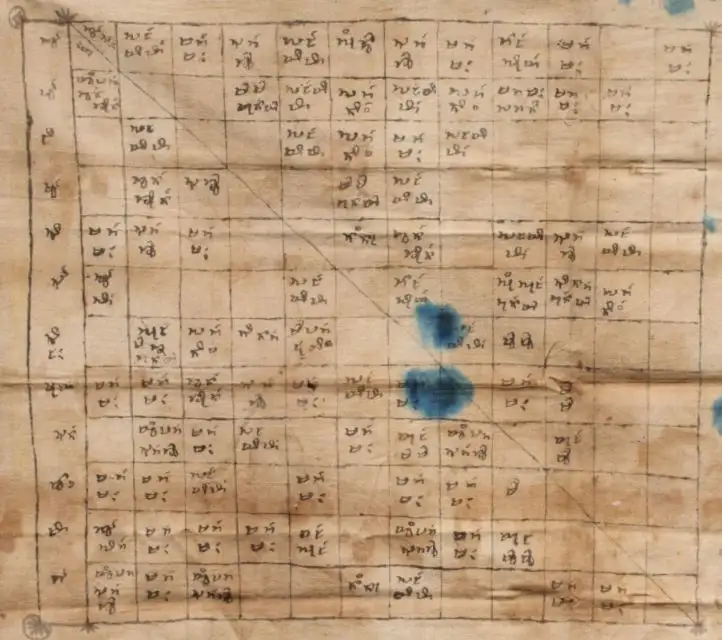
In Dai Ahom terms, we call the Heavenly Stem as Mother (māe) and Earthly Branch as Child (lūk) and the ten mothers are combined with twelve children, each six times to make sixty combinations in the following order
| 1 | 2 | 3 | 4 | 5 | 6 | |
|---|---|---|---|---|---|---|
| 1 | k,pq! c]$ kàap tsâu | k,pq! mCtq$ kàap mêt | k,pq! snq kàap san | k,pq! sI [a$ kàap si ngâ | k,pq! sI kàap si | k,pq! yI# kàap yí |
| 2 | l,pq@ pw$ lāap pâo | l,pq@ k]$ lāap kâu | l,pq@ rw$ lāap râo | l,pq@ mUtq! lāap mòt | l,pq@ s]$ lāap sâu | l,pq@ mw$ lāap mâo |
| 3 | h,j# yI# háai yí | h,j# c]$ háai tsâu | h,j# mCtq$ háai mêt | h,j# snq háai san | h,j# sI [a$ háai si ngâ | h,j# sI háai si |
| 4 | mE[q# mw$ mérng mâo | mE[q# pw$ mérng pâo | mE[q# k]$ mérng kâu | mE[q# rw$ mérng râo | mE[q# mUtq! mérng mòt | mE[q# s]$ mérng sâu |
| 5 | pEkq# sI pérk si | pEkq# yI# pérk yí | pEkq# c]$ pérk tsâu | pEkq# mCtq$ pérk mêt | pEkq# snq pérk san | pEkq# sI [a$ pérk si ngâ |
| 6 | ktq# s]$ kát sâu | ktq# mw$ kát mâo | ktq# pw$ kát pâo | ktq# k]$ kát kâu | ktq# rw$ kát râo | ktq# mUtq! kát mòt |
| 7 | xUtq# sI [a$ xót si ngâ | xUtq# sI xót si | xUtq# yI# xót yí | xUtq# c]$ xót tsâu | xUtq# mCtq$ xót mêt | xUtq# snq xót san |
| 8 | rU[q$ mUtq! rông mòt | rU[q$ s]$ rông sâu | rU[q$ mw$ rông mâo | rU[q$ pw$ rông pâo | rU[q$ k]$ rông kâu | rU[q$ rw$ rông râo |
| 9 | tw! snq tào san | tw! sI [a$ tào si ngâ | tw! sI tào si | tw! yI# tào yí | tw! c]$ tào tsâu | tw! mCtq$ tào mêt |
| 10 | ka! rw$ kà râo | ka! mUtq! kà mòt | ka! s]$ kà sâu | ka! mw$ kà mâo | ka! pw$ kà pâo | ka! k]$ kà kâu |
For calendrical timekeeping, each month is divided into 3 three wōng (called xún in Chinese) or three ten-day cycle. That is to say, in traditional terms Dai Ahom people have ten days in a week. This calendar is however only used for ritual purposes such as marking auspicious days for battle, agricultural harvest, etc. Otherwise for other activities, Dai people follow the same 7-day in a week calendar as the rest of the people.